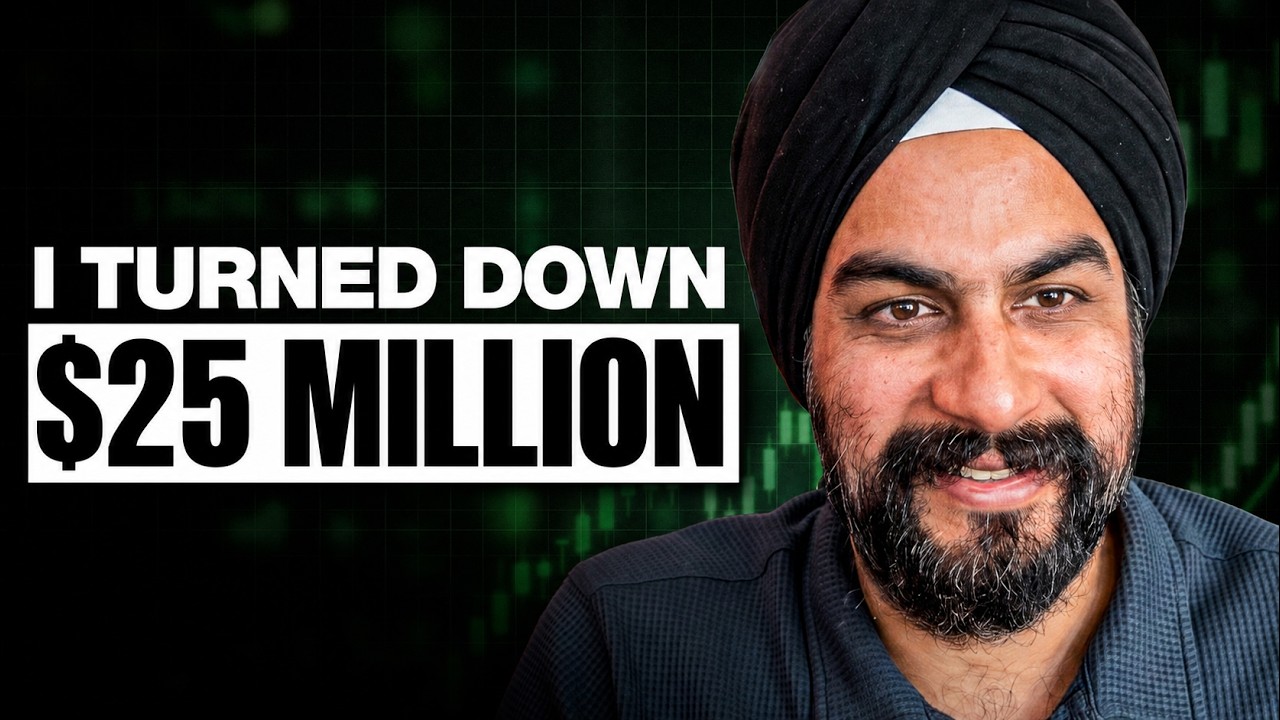
He Turned Down $11 Billion for Craigslist
Craig Newmark started Craigslist in 1995, turned down an $11 billion offer, and has given away $570 million. He talks about his moral compass, living on $80 Skechers, and his plan to give away $1 billion before he dies.

Craig Newmark started Craigslist off a mailing list in 1995. He turned down what he says was an $11 billion offer, and since then he's given away $570 million through his foundation, aiming for a billion before he dies. He funds NYPD bomb squad gear, an NYU cardiologist's AI research, Wikipedia, journalism schools, and pigeon rescue. He's 73, hasn't owned a car in ten years, and just upgraded from $50 Skechers to $80 Skechers.
Like all Moneywise episodes, Craig breaks down his net worth, income, portfolio, and monthly expenses and then I, your humble host, pick it all apart.
We also went deep on: the Sunday school lesson that set his moral compass, why he turned down $11 billion, how he stepped down as CEO because he "sucked" at management, his plan to give away $1 billion before he dies, why he lives on books and streaming subscriptions, funding the NYPD bomb squad and AI heart research, and his plan to train an LLM to keep making his philanthropic decisions after he's gone
Below you'll find my summary of the episode along with the entire transcript.
And by the way...this podcast, the concept of it came from Hampton. Hampton is a private, highly vetted community for high net worth founders started by Sam Parr. Members range from companies doing 3-5 million in revenue all the way up to hundreds of millions. The reason we started this podcast is because there are amazing conversations about money and growing companies that typically happen only behind closed doors, and we thought it would be awesome to share all of this information. If you're a CEO, founder, or business owner, check this out. New Moneywise episodes come out weekly.
Listen to this episode on:
Now, below are the notes and the full transcript.
The Numbers
- $11 billion — the offer Craig turned down for Craigslist
- $570 million — total philanthropic giving to date (including commitments)
- $530 million — cash already distributed
- $1 billion — his giving target before he dies
- $35/month — what he paid for hosting when Craigslist started in 1995
- $150K — donated to pigeon rescue and the Wild Bird Fund
- $80 — his new Skechers (upgraded from $50)
- $1,000+ — his most expensive recent purchase: a jacket his wife told him to buy
- 2 homes — New York and San Francisco (kept for family ties)
- 0 cars — hasn't driven in 10 years
- 24 — nephews and nieces who receive his hand-me-down gadgets
- 10–20 years — his self-estimated timeline to give away the full billion
From Sunday School to a Moral Compass
Craig grew up in Morristown, New Jersey. His dad died young, but his family sent him to Sunday school at the Jewish Community Center, where a married couple from Europe — Mr. and Mrs. Levin — became the teachers who shaped the rest of his life.
"They set my moral compass, helping me understand I should treat people like I wanna be treated. I should know when enough is enough. And I should think about being my brother's keeper, my sister's keeper, whatever that means."
Craig describes himself as the prototypical nerd — thick black glasses taped together, a plastic pocket protector, and almost no ability to read social cues. He says he may have invented the nerd stereotype, and even now, he can only fake social fluency for about 90 minutes before he "shows signs of wear and possibly gets cranky."
Starting Craigslist on $35 a Month
In 1995, Craig started a mailing list. A year later, he realized he could write code that turned emails into web pages — instant web publishing, basically for free. The most he paid was $35 a month for hosting.
He ran it alone for three years, tried volunteers for a year (that didn't work — "people need to be committed and paid"), and in early 1999, Craigslist became a real company.
That's when VCs and bankers started circling with what would have amounted to billions. But Craig thought back to Mr. and Mrs. Levin and chose to minimally monetize instead — mostly just charging for ads that people already had to pay for elsewhere.
"If I live a really good life and help my family do that, the rest is discretionary and might become a burden."
Turning Down $11 Billion
The number that keeps circulating is $11 billion. Craig says the story has been retold incorrectly over the years, but after analysis, that's roughly what VCs and bankers were offering. His reaction?
"Turning it down, I had a little twinge, but then my values, my moral compass asserted itself, thinking having this much money is bullshit."
He wasn't thinking about how much more he could give away with that money. It simply didn't feel right.
"I could buy a yacht, but what's the point? I could buy a fancy car. What's the point? And I just didn't get it, and that may tie into my dysfunction as a nerd because I didn't understand the social cues associated with prestige items."
At one point, Google wanted to buy the whole company too. They passed on that as well. In an odd twist, Craig now works with some of the same Google people on scam-fighting and cybersecurity projects.
"I Suck at Management"
In 2000, Craig made what he calls a tough decision: he stepped down completely from running Craigslist.
"I had no talent or taste for making tough decisions. Being a manager — hiring, firing, where do you put resources — those are difficult decisions, and I hated doing them, and I wasn't all that good at them."
He hired Jim Buckmaster to lead technology, and Jim turned out to be great at the hard calls. Craig gave up all management influence and became full-time customer service.
"If you wanna treat people like you wanna be treated, you do good customer service."
He stayed on the board, where powers are "intense but very limited." Jim maintained the same minimal monetization philosophy, and to Craig's surprise, Craigslist has done extremely well financially.
$570 Million and Counting
Craig's philanthropic giving sits around $530 million in direct distributions, or about $570 million when you include committed pledges tied to milestones. His goal is $1 billion before he dies — he estimates 10 to 20 more years.
The two biggest buckets: military families and veterans, and fighting scams and cyberattacks. Both, he says, are about "protecting the country and helping regular people fight bad guys."
He also funds journalism — including Wikipedia, Columbia Journalism School, the CUNY Journalism School, and The Forward — though not as much as he used to. And he recently started funding the NYPD bomb squad's protective gear and radios after learning they didn't have the budget for current-generation equipment.
"Our enemies have already infiltrated what they call critical infrastructure, like our water supplies. If the Chinese army shuts off our water, that would be bad."
His advice to other high-net-worth individuals: find causes you believe in, figure out a reasonable contribution, and don't give big checks all at once. Spread it across years, contingent on milestones.
"You gotta do due diligence on this stuff because there are nonprofits which are running very plausible-sounding scams."
Living on Books, Streaming, and $80 Skechers
Craig and his wife live far below their means. They don't own a car — he hasn't driven in 10 years. They have two homes (New York and San Francisco, the latter kept for family ties), and his biggest personal indulgence is sushi.
When Daniel asked for one example of a "crazy expensive" purchase, Craig pointed to a jacket his wife told him he needed — well over $1,000. And his new shoes? An upgrade from $50 Skechers to $80 Skechers.
"My idea of luxury is having a walk-in shower with grab bars."
His regular spending: books, streaming services, the occasional new cable or stand to make his desk setup look neater. And whatever he replaces gets passed along to his 24 nephews and nieces.
"I can buy whatever luxuries I want. Like, I get all the books I want."
An LLM to Keep Giving After He's Gone
One of the most fascinating parts of the conversation: Craig is thinking about training a large language model on his decision-making so his philanthropic work can continue after he dies.
"I could train a system to know how I would respond in a lot of circumstances. I may not last long enough to perform due diligence on my contributions. A really well-trained LLM could help make those decisions."
But he's aware of the irony — and the risk.
"My problem is that a smart enough system could think that my continued existence was a distraction, an annoyance, interference in this decision-making. So maybe it would just decide that it should dispose of me."
He's also funding an NYU Langone cardiologist — the same doctor who performed a heart ablation that Craig says arguably saved his life — to train LLMs to detect AFib and low ejection fraction from ECGs, catching heart problems early without expensive tests.
"I much prefer a nonprofit to control that technology than an intensely for-profit organization who would milk it."
Why Craigslist Still Looks Like It's 1999
The site's famously minimal design isn't an accident or neglect — it's a deliberate choice validated by users over decades.
"When I made the first site, I didn't know how to do real design. But I knew to put something up there that will be fast and simple because I wanted people to look at it, and it would be obvious what they do."
Jim Buckmaster kept that philosophy. And every time they talked to users, the feedback was the same: simple and fast helps people get through the day. They want to find a job or apartment or buy a table — not navigate fancy animations.
"The only people who seem to want it fancier are designers."
The Nerd Who Funded a Pigeon Rescue
Yes, Craig really does fund pigeon rescue — about $150K to the Wild Bird Fund on the Upper West Side, which is opening a second location in Brooklyn.
"The pigeons made it known to me. They're birds. I love birds, and they're graceful and smart. And I figure they may be our replacement species if we're not careful."
He paused, then added: "Although frankly, rats have hands and conceivably opposable thumbs someday."
This is Craig in a nutshell — deeply serious philanthropy wrapped in the kind of humor that makes you do a double take. He calls himself a nerd, says he's "certifiable," and credits Dr. Seuss's If I Ran the Zoo (1950) with inventing the nerd stereotype to describe him.
"I'm not the nerd you want, I don't think, but I'm the nerd you got."
Other Key Quotes
"Having this much money is bullshit. — Craig Newmark, on turning down $11 billion"
"I should treat people like I wanna be treated. I should know when enough is enough. — Craig Newmark, on the Sunday school lesson that shaped his life"
"If I live a really good life and help my family do that, the rest is discretionary and might become a burden."
"I'm amused to have more money than I need and see no point in having it."
"Craigslist, from my point of view, during my time, was a happy accident. I did something simple, listened to people, committed, followed through."
"Fast, simple, and obvious. Those are great design skills."
"I crave community. I have more of a social appetite. I need people more than I thought. Despite being a nerd, I'm still figuring that out."
"I'm not the nerd you want, I don't think, but I'm the nerd you got."
Links You Might Like
- Join Hampton Community: https://joinhampton.com
- Craigslist
- Craig Newmark Philanthropies
- Wild Bird Fund NYC
- Daily Body Coach (sponsor)
- MoneyWise Podcast: Full episode archive
- Daniel Berk on X
Full Transcript
Daniel Berk: When you got an offer for eleven billion dollars, what did that feel like?
Craig Newmark: Turning it down, I had a, a little twinge, but, you know, then my, uh, values, my moral compass asserted itself, thinking having this much money is bullshit.
Daniel Berk: Was there a point at any time in that deal mechanic that you thought eleven billion dollars is a lot, and I could actually give away even more?
Craig Newmark: It just, uh, didn't, uh, feel right from the beginning, and I thought about what I could do with that. Like, I could, uh, buy a yacht, but, uh, what's the point? I could buy a fancy car. Uh, what's the point? And I just didn't get it.
Daniel Berk: Craig Newmark started Craigslist in nineteen ninety-five off a mailing list. He turned down what he says was an eleven billion dollar offer, and since then he's given away five hundred and seventy million dollars, and he wants to give away a billion dollars before he dies. He funds cybersecurity work with the FBI, gear for the NYPD bomb squad, military families, journalism, a whole bunch of stuff, and even does AI research projects trying to catch heart problems early. Craig is such an interesting dude. And by the way, this conversation started the way most Moneywise episodes do, inside Hampton, a private network for founders and CEOs. Hampton is where founders who do three million or more in revenue or who have exited for ten million or more talk about all the details of their lives, their business, the money they have to spend, where their burn and all their revenue comes from, if they're raising or not. These episodes tackle the same problems that Hampton founders do. If that's the kind of room you wanna be in, go to joinhampton.com. In this episode, we'll go through the actual math, what eleven billion dollars turned down looks like and five hundred and seventy million dollars given away actually breaks down to, and whether or not giving away that much money actually makes him happy and why he even gives it away at all. And while you're here, please subscribe to the Moneywise channel. That means more to me than you might think. Now, let's get into the episode. This is Moneywise. I'm Daniel Burke. Here's Craig Newmark from Craigslist. I would love for you to tell me, um, a little bit about the way that you were raised and grow... You grew up around, you know, a very specific lifestyle without the Craigslist story, and so let's start there. Tell me about who Craig is before Craigslist.
Craig Newmark: Raised in New Jersey. Uh, dad died early, but they did send me to a good Sunday school, and this was at the Jewish Community Center in Morristown, New Jersey. In a way, I got lucky. I got a real, uh, good, uh, pair of teachers at first, married couple, uh, from Europe. I only learned their story, uh, well, a couple years ago. But, uh, I was paying attention. They set my moral compass, helping me understand I should treat people like I wanna be treated. I should know when enough is enough. And, uh, I should, uh, think about being my brother's keeper, my sister's keeper, whatever that means. How literally do I take it? Not, uh, long ago, I learned maybe that I should do things like selling possessions and feed the poor.
Daniel Berk: Yeah.
Craig Newmark: Which from my point of view is the same lesson.
Daniel Berk: Yeah.
Craig Newmark: And I just have to avoid taking it too literally.
Daniel Berk: Yeah.
Craig Newmark: Because growing up then, I was really good at, uh, science and technology.
Daniel Berk: Yeah.
Craig Newmark: And grew into the, uh, nerd stereotype. However, as far as I could tell, doing a lot of reading, I may have invented the nerd stereotype. Not only limited social skills, but thick black glasses taped together, a plastic pocket protector. And again, I, uh, just was completely oblivious to social cues.
Daniel Berk: Okay.
Craig Newmark: And nowadays, I'm still largely oblivious to social cues. I can fake it for about ninety minutes.
Daniel Berk: Okay.
Craig Newmark: After which point, uh, I will show signs of wear and possibly get cranky.
Daniel Berk: Yeah.
Daniel Berk: And when you started Craigslist in ninety-nine, my understanding is part of the reason why you hired a CEO was due to some of those social cues and management styles. Tell me more about that. What was your thinking?
Craig Newmark: I started in, uh, ninety-five.
Daniel Berk: Nine-five. You had-
Craig Newmark: Well, you're almost right. Started the thing in ninety-five, uh, mailing list. And then about a year after, I realized I am a programmer and email has a fixed format, so I can write code which would turn emails into web pages. I had instant web publishing basically for free. I mean, the most I paid in that period was thirty-five bucks a month for hosting services. And I basically ran it by myself for three years, uh, ran it with, uh, volunteers for one year. That didn't work out.
Daniel Berk: Yeah.
Craig Newmark: People need to be committed and paid.
Daniel Berk: Yeah.
Craig Newmark: And so in early ninety-nine, Craigslist became a real company.
Daniel Berk: Right.
Craig Newmark: And I had to make a tough decision. At that point, um, bankers, VCs back in San Francisco wanted to throw what turns out to be billions at me to do things the usual way. But thinking back to Mr. and Mrs. Levin, I'm thinking, "I know when enough is enough."
Daniel Berk: Yeah.
Craig Newmark: If I live a really good life and help my family do that, uh, the rest is discretionary and might become a burden. And so I decided to min... to, uh, minimally monetize Craigslist. Mostly just charge some people for ads that they already had to pay for elsewhere. The ads weren't as effective. So that was pretty good. That's been expanded over the years, particularly in New York, where apartment brokers went out of control about fifteen years ago, posting the same ad multiple times a day. Everyone hated that.
Daniel Berk: Yeah.
Craig Newmark: Brokers and apartment seekers. So I spoke to a lot of brokers, asking them what was a fair price per ad. The successful brokers said twenty bucks. The ones who were just started say, said ten bucks because normally a new broker would only make twenty K a year.
Daniel Berk: Yeah.
Craig Newmark: And even fifteen years ago in New York, not enough.
Daniel Berk: Sure.
Craig Newmark: You know, you had to work three jobs or more.
Daniel Berk: Yeah.
Craig Newmark: So in a sense, that's the gist of, uh, Craigslist. I mean, you're right. In two thousand, I realized as a manager, I suck.
Daniel Berk: What, what, what do you-- when you say that, what do you mean? 'Cause I've, I've seen that online, and you've said that before.
Craig Newmark: Yeah, I had no talent or taste for making tough decisions. And being a manager, hiring, firing, where do you put resources, those are difficult decisions, and I hated doing them, and I wasn't all that good at them. But I just hired Jim to lead technology, and he was good at them.
Daniel Berk: Yeah.
Craig Newmark: So I stepped down completely. I became full-time customer service.
Daniel Berk: Yeah.
Craig Newmark: Because if you wanna treat people like you wanna be treated, you do good customer service.
Daniel Berk: Yeah.
Craig Newmark: And I gave up all management influence and responsibilities. I mean, I stayed on the board, and I'm on the board now, but board powers are intense but very limited.
Daniel Berk: Yeah.
Craig Newmark: So, uh, Jim has been running things. He maintained the monetization philosophy. And to my surprise, Craigslist has done really well financially.
Daniel Berk: Yeah.
Craig Newmark: That puts me in a, uh, let's say in a moral dilemma.
Daniel Berk: Yeah.
Craig Newmark: I'm making lots more than I need. What do I do with that? And in some-- sometimes, in some respects, I've even literally helped feed the not-so-much poor as food insecure. That's the term of our now. And I focused during the pandemic on military families.
Daniel Berk: Yeah. When you think of the, the shift from this website that was primarily like a one-to-one messaging, uh, social forum in, in many respects in nineteen ninety-five to what it became, what did that feel like when you started to see, you know, seven and eight and nine and ten figures on a balance sheet or VC offer? How did that feel?
Craig Newmark: It felt like, uh, good and surreal. I some ways didn't believe it was happening.
Daniel Berk: Yeah.
Craig Newmark: I'm pleased, but I'm again, uh, challenged. I'm perplexed. What will I do about this? And at first, you know, the company accumulated money because that's financially responsible.
Craig Newmark: But at some point, people with equity, uh, got some. And I'm thinking that, you know, I would keep some for myself and my family. Uh, Mrs. Newmark has the largest vote there, seriously.
Daniel Berk: Yeah.
Craig Newmark: But I should do something like putting all my Craigslist equity into charity. Yeah. And I did that officially a few years ago. I created what they call a five oh one C four foundation. I've made that decision shortly before turning seventy. At this, I'm very, very old.
Daniel Berk: You do not look a day over sixty.
Craig Newmark: Thank you. But, uh, the, uh, in December, it'll be seventy-four. And so I called the thing the Septuagenarian Fund-
Daniel Berk: Yeah ...
Craig Newmark: because I've limited imagination, but I do have a sense of humor-
Daniel Berk: Yeah ...
Craig Newmark: which I have a hard time stopping, except nowadays, sometimes I can tell when I'm not being funny.
Daniel Berk: Yeah.
Craig Newmark: And so, uh, I put it all in there, and now, uh, I'm embarked on a, uh, process of spending it all down during my lifetime.
Daniel Berk: And when that shift happened, when Craigslist started to make real money, before you put all of it into a Septuagenarian Fund, where was that money going early days? There was no real overhead, very few employees.
Craig Newmark: That's right. The company-- Well, Jim runs it pretty lean.
Daniel Berk: Yeah.
Craig Newmark: Uh, frankly, uh, uh, not much in the way of bullshit.
Daniel Berk: Yeah.
Craig Newmark: Um, there is a customer service and billing department. Um, there's, uh, technology, and then there's Jim.
Daniel Berk: Yeah.
Craig Newmark: Um, one point in, uh, two thousand, we experimented putting a couple ads in HR magazines, decided that wasn't, uh, useful, and so, uh, never marketing. For the most part, word of mouth helped the site, uh, succeed. We relied on that, uh, too much in some ways when bad actors, oh, tried to, uh, hurt us, and we should have fought back, but we didn't.
Daniel Berk: Yeah. Putting that amount of equity into a five oh one C four, a lot of people would say that's a really interesting decision. And the moral dilemma, I think, is, uh, I would just love to know more. What, what is the moral dilemma you felt about amassing wealth for yourself versus, you know, socially giving back to these nonprofits and five oh one C fours?
Craig Newmark: Well, I don't wanna over-dramatize the, uh, my thinking. Back then, I do recall thinking that, gosh, it's nice to have all that money, not feeling insecure. Uh, my family grew up, uh, not poor, but not middle class either. Um, but I figured, uh, at some point for sure I had, uh, more than enough, and people were already approaching me about good things I could do with nonprofits. Most of the first requests were just for help consulting about what's it take to build community. Because back then, Craigslist, even though classifieds, built community-
Daniel Berk: Yeah ...
Craig Newmark: uh, to my surprise. And so I'm thinking that I'm making all this money. I feel comfortable now. I could start giving it away to, uh, people who might need it. I'm beginning to see the need for, uh, uh, for nonprofit work, for funding in areas that didn't seem to get enough, like, uh, experiments in journalism, like support for, uh, military veterans. Um, now and then I would do something miscellaneous, I think. Started small, got organized in two thousand fifteen, two thousand sixteen, and I've just been getting my act better and better together. I take some pains to remain a, uh, amateur because I'm finding that foundations which don't... Well, if you do the formal things, the best practices that foundations are supposed to be, sometimes those are paralyzing.
Daniel Berk: Yeah.
Craig Newmark: So I'm getting more professional. But frankly, uh, what I do is when I need help, I gather my, uh, networks, ask for help, make a decision.
Daniel Berk: Yeah. That works. Sure. When you think of the philanthropic division of your wealth and what you want to leave and how you want to spend some of that money, what's your thought process behind where the money goes and, and even how much you give away and in what cadence?
Craig Newmark: Um, I guess, uh, maybe I'm a little bit of a contrarian.
Craig Newmark: I'll find areas which need help and which people may say they're even-- uh, lots of people are helping and they're not. So I would fill in. Uh, that includes, uh, military families and vets.
Daniel Berk: Yeah.
Craig Newmark: They were getting some real support in the decade after nine eleven.
Daniel Berk: Yeah.
Craig Newmark: Um, but that has, uh, tapered off. I just read a newer report about that this morning from, uh, Bob Woodruff Foundation.
Daniel Berk: Yeah.
Craig Newmark: And I-- Well, I was ra- remember, raised in Morristown, New Jersey, which is also the capital of the revolution. Washington spent a couple of really hard winters there with the, uh, Continental Army. And so all the growing up all around me are reminders of what, uh, the revolutionaries had to work with, how much they suffered because they didn't have adequate anything.
Daniel Berk: Yeah.
Craig Newmark: And I figured, well, I can't help them out, but military families and vets are hurting.
Daniel Berk: Yeah.
Craig Newmark: And I've helped.
Daniel Berk: You told me you want to give away how much money by the time you pass away?
Craig Newmark: Uh, by the time I pass away, an aggregate of a billion.
Daniel Berk: Yeah.
Craig Newmark: Um, I am not a real good investor, but I've done a good enough job that I can see the, the money and the foundations growing to that extent b- b- between-- in between ten and twenty years. That's my s-- uh, horizon.
Daniel Berk: Yeah.
Craig Newmark: Because I'm guessing at seventy-three I'll live another ten to twenty years.
Daniel Berk: Yeah, I think so.
Craig Newmark: Um, that's my hope. The cardiologist next week, so far he's, uh, told me he's been extending my warranty.
Daniel Berk: Okay. Well, yeah, fingers crossed for the cardiologist appointment.
Craig Newmark: That's a cardiologist, uh, joke.
Daniel Berk: Yeah.
Craig Newmark: And, uh, I may, uh, uh, I may use it preemptively.
Daniel Berk: Yeah. That's great. Uh, yeah. I, I, I have some cardiology stuff running in my family, so I, I relate to, to a lot of that. Yeah. When you-- So a billion by the time you die, ten to twenty years, I mean, maybe longer, we, we don't know. How much have you given away already to philanthropy?
Craig Newmark: Um, depending on how you wanna measure, uh, right now it's around, I'm guessing a little bit, five hundred, uh, thirty million.
Daniel Berk: Wow.
Craig Newmark: Um, when I consider commitments, like dollars that I've promised I would provide given milestones, that goes up to about five seventy.
Daniel Berk: Okay. So when I think of philanthropy, I'm in a very different situation. Um, but I give to causes I care about, and I give to people I want to see succeed or who need a, you know, particular, you know, money for something. And I'm talking a thousand dollars here, five thousand dollars there. Five hundred and seventy million dollars is a lot of money. Did you, did you-- Early on, did you think you would give away that much money?
Craig Newmark: Um, I don't think it's a lot of money in, in, uh, philanthropy. There are people giving away billions like Mackenzie Bezos. Um, what matters is, uh, oh, let's say the percentage of your, uh, net worth. I guess what matters is how committed you are.
Daniel Berk: Mm-hmm.
Craig Newmark: And people do what they can. There's a lot of... Well, first, getting through the day sometimes is just too much of a challenge. Making ends meet, too much of a challenge. And it's not fair to, uh-
Daniel Berk: Expect people who are working two jobs to feed their family, they're not gonna contribute to anything, and I don't want them to. They should be recipients.
Craig Newmark: Yeah. Um, me, I figure I'm, uh, doing what I can, what makes sense, subject to negotiations with Mrs. Newmark.
Daniel Berk: Yeah. I, I like that answer. And when you think of the, the delta from five seventy to a billion, do you have some places or, or causes in mind beyond the ones you've shared already that you really foresee giving to?
Craig Newmark: Um, right now, well, there's two big, uh, buckets that, that I contribute to. Military families and vets, and then fighting scams and fighting cyberattacks.
Daniel Berk: Yeah.
Craig Newmark: Uh, both big buckets are about protecting the country and helping regular people, uh, well, fight bad guys.
Daniel Berk: Yeah.
Craig Newmark: So those are areas where I'm, uh, where I've st- uh, stood up. I'm also helping journalism, but not as much as I used to.
Daniel Berk: Yeah.
Craig Newmark: Um, like I'm, uh, providing substantial support for, uh, Wikipedia, for the, uh, City University, uh, Journalism School, uh, for the Columbia Journalism School, and some other things like the Forward, which is a historical, uh, New York-based, uh, Jewish newspaper. Okay. Um, beyond that, sometimes I'll support some things on a whim like, well, I love birds. I have a sense of humor. I really do support pigeon rescue.
Daniel Berk: Which I wanted to ask. Pigeon rescue, especially in New York, sounds like a bit because people initially think, "Why rescue pigeons? They're a nuisance." But walk me through your thought here. I mean, how did you, how did you come up with that idea even originally?
Craig Newmark: Uh, well, the pigeons made it known to me. Yeah. And they're birds. Again, love birds, and they're, they're graceful and smart. And I figure they may be our replacement species if we're not careful. Although frankly, uh, uh, rats, uh, have, uh, hands and conceivably ad- op- opposable thumbs someday.
Daniel Berk: Sure. How much have you given to birds or to-
Craig Newmark: To pigeon rescue and birds, yeah, I'm guessing about a hundred and fifty K.
Daniel Berk: Okay.
Craig Newmark: Particularly for the Wild Bird Fund-
Daniel Berk: Yeah ...
Craig Newmark: Upper West Side 'cause they're opening up a place in, uh, in, uh, Brooklyn.
Daniel Berk: Yeah.
Craig Newmark: And this is, uh, God's work, I guess, even if, uh, it is secondary to, uh, feeding people. Yeah. In New York, aside from military families, I really like God's Lovely Deliver.
Daniel Berk: Yeah. Philanthropy seems to be... And I would love for you to correct me if I'm wrong here, but from what I'm hearing, it seems to be the way that you're solving the way you feel about having amassed, let's say hundreds of millions of dollars. Is that why you're giving money away?
Craig Newmark: Uh, that's not it.
Daniel Berk: Okay.
Craig Newmark: It's just that I really, uh, I guess I internalize brother's keeper, sister's keeper-
Daniel Berk: Yeah ...
Craig Newmark: uh, selling what I have and feeding the poor. I guess I internalized that long ago, but when people ask me that question, which people have been asking for ten years or more-
Daniel Berk: Yeah ...
Craig Newmark: I realize that's my motivation. Um, I'm not trying to prove anything.
Daniel Berk: Yeah.
Craig Newmark: Uh, I know, uh, really rich people think, uh, how much money they have is keeping score, and if you give away a billion, that affects your place in the, uh, leaderboard. I don't think that way. I'm, uh, amused to have more money than I need and see no point in having it. I-- my wife and I live far below our means.
Daniel Berk: Sure.
Craig Newmark: Uh, my idea of luxury is having a walk-in shower with grab bars.
Daniel Berk: Yeah.
Craig Newmark: That also reflects the fact that I now understand why really old people want to be able to walk into their shower-
Daniel Berk: Sure ...
Craig Newmark: and then have a bar to grab onto.
Daniel Berk: Yeah. And that's not a joke.
Craig Newmark: Yeah. No, I know.
Daniel Berk: Uh, I would say I, I like that too, and I'm not quite there yet. So, um, that's nice. So be- beyond philanthropy, when you think of living below your means and what you're spending personally on, I mean, what are some of those things that you value beyond the walk-in shower? I mean, where is personal spending today?
Daniel Berk: All right, Money Wise listeners, quick reality check. It's that time of year when you catch yourself thinking, "Why didn't I start earlier?" We knew summer was coming. It always does. And if you keep doing what you usually do, you'll blink, and it'll be New Year's again. Same story, same body, same excuses. That's why today's sponsor is Daily Body Coach. Daily Body Coach is a premium online coaching service for ambitious entrepreneurs and executives who want their body to perform at the same level as their business. Training is built around your schedule. Nutrition is built around your specific needs. There are clear targets and clear metrics. And most importantly, there's no guesswork, just science and a multidisciplinary team covering training, nutrition, and the psychology behind behavior change. Daily Body Coach is run by Anthony Monica, who's a Hampton member himself. And in fact, a bunch of other Hampton members are using it and have been showing great results.
Daniel Berk: Yes, you'll look better this summer, leaner, stronger, sharper. But the real win is that you'll stop carrying a body that's taxing your energy, confidence, and longevity. If you're serious about fat loss, muscle gain, and building a body that supports your standards, don't think about it. Don't bookmark it. Don't push it to Monday. Click the link in the description, and I'll hook you up with Anthony directly. Check out dailybodycoach.com/moneywise. That's dailybodycoach.com/moneywise. Um, well, basically whenever I, uh-
Craig Newmark: Uh, feel like indulging myself in more expensive foods. Like, I like sushi.
Daniel Berk: Yeah.
Craig Newmark: I'll do that. Although, no matter where you go, what you eat in New York, in Manhattan, you're s- you're spending it expensively.
Daniel Berk: Yeah, it's like $100 sushi roll wherever you look.
Craig Newmark: I, I don't think I'm capable of doing that. But, um, we moved here five years ago from San Francisco. We still have family ties there, and friends, so we kept a place there. So I don't need two homes, uh, but I have 'em.
Daniel Berk: Okay. Just two, or-
Craig Newmark: Just, just two. But people, I guess you'd say, in my position often have a half dozen homes. No point in that. Uh, we don't have a car, and I haven't driven in, uh, 10 years.
Daniel Berk: Great. That's-- So beyond the, the obvious spending of groceries and eating, are you spending much money given, uh, any given month?
Craig Newmark: Um, it's hard to say, uh, because my wife tracks all that-
Daniel Berk: Yeah ...
Craig Newmark: ... which I really appreciate.
Daniel Berk: Sure. Great.
Craig Newmark: Um, I can buy whatever luxuries I want. Like, I get all the books I want.
Daniel Berk: That's great.
Craig Newmark: I, uh, h- I'm on all the streaming services I want. I do love books and TV.
Daniel Berk: Yeah.
Craig Newmark: And then now and then there I'll buy, uh, let's say a new charger or cable to make my desktop neater.
Daniel Berk: Okay.
Craig Newmark: Because I do like things tidy. And I'm not exaggerating. I will, uh, make things, uh, neater. Sometimes ooh, I'll get this new stand-
Daniel Berk: Yeah ...
Craig Newmark: ... and my setup will look even cooler.
Daniel Berk: Yeah.
Craig Newmark: And then I'll... Usually the, uh, what-- no matter what it is, even a Chromebook, we have 24 nephews and nieces, so someone will want it.
Daniel Berk: Yeah.
Craig Newmark: So you know, you're buying something for you, but eventually it's something for someone else too.
Daniel Berk: Yeah.
Craig Newmark: Yeah. Well, kids in school use Chromebooks these days. When I move on to something, uh, better, they get something better than they previously had.
Daniel Berk: Yeah. That's, that's great. So give me one practical example. If y- you know, a, a few months go by, there's something you really want that's, let's call it expensive, relatively. One example of something you've bought that's crazy expensive.
Craig Newmark: Um, from my point of view, this, uh, jacket is far more expensive than anything I got. But my wife, uh, told me that I needed something that genuinely fit me.
Daniel Berk: How much did the jacket cost?
Craig Newmark: I think it was, uh, well over 1,000.
Daniel Berk: Okay.
Craig Newmark: And it does, uh, fit right.
Daniel Berk: Yeah.
Craig Newmark: And my, uh, friends, uh, uh, like it.
Daniel Berk: Yeah.
Craig Newmark: And it, uh, reminds me that I did lose weight using a GLP-1 drug, and it works. So, uh, it was a, uh, wise purchase.
Daniel Berk: Yeah.
Craig Newmark: I'm wearing new shoes. It was-- I had been wearing, uh, $50 Skechers.
Daniel Berk: Yeah.
Craig Newmark: And now I'm, uh, wearing $80 Skechers.
Daniel Berk: That's a huge upgrade. Yes. Craig turned down an $11 billion offer, and his big purchase this year was upgrading from $50 Skechers to $80 Skechers. That is not a bit, that's his literal answer. This is why I love Hampton, the private network for founders. Half of what gets talked about in Hampton isn't the number. It's what you do once the number stops changing your Tuesday. Craig's answer is basically nothing. He gets whatever he wants, and what he wants is a new pair of shoes. Check out joinhampton.com if you wanna discuss your money, businesses, and lifestyles with other founders who actually get it. Yeah, okay. I love that. Yeah, and, and the, the jacket looks great. W- I wanna circle back to the Craigslist offer that you turned down.
Craig Newmark: Okay.
Daniel Berk: When you got an offer for $11 billion, what did that feel like? And how-- You to- you told me about a moral dilemma earlier.
Daniel Berk: How did that kinda wrap into that?
Craig Newmark: The way that story has been retold got it wrong. Um, the deal, and I think the guy, guy at first got it right when I decided to not to sell it, what the VCs and bankers were offering me amounted to, uh, 11 billion. That's our analysis in retrospect, both this other guy and that's kind of what I guessed too. Um, and that's all guesswork. And turning it down, I had a, a little twinge, but, you know, then my, uh, values, my moral compass asserted itself, thinking having this much money is bullshit.
Daniel Berk: Wow.
Craig Newmark: And since then, um, at one point we were, uh, shop... Well, let's see, someone I gave equity to wanted to sell it. And, uh, we w- we worked together to shop it around. Google wanted to buy, uh, the, uh, well, not just that equity, but the whole company. And we decided we didn't, uh, wanna do that. Uh, but now in odd coincidence, I work with some of the same Google people when it comes to scam fighting and better, uh, cybersecurity.
Daniel Berk: So you, y- there was a point when you twinged, and the moral compass kinda took over. Was there a point at any time in that deal mechanic that you thought, "$11 billion is a lot, and I could actually give away even more"?
Craig Newmark: Um, I wasn't thinking that far ahead. It just, uh, didn't, uh, feel right from the beginning, and I thought about what I could do with that. Like, I could, uh, buy a yacht, but, uh, what's the point?
Daniel Berk: Right.
Craig Newmark: Uh, I could buy a fancy car. Uh, what's the point? And I just didn't get it, and that may tie into my dysfunction as a nerd because I didn't understand the, uh, social cues associated with prestige items. So I just didn't, uh, bother with, uh, that kind of stuff. Now I, uh, do get some stuff which is kind of prestige in a way, I guess.
Daniel Berk: Yeah.
Craig Newmark: Um, although if you look at my watch, it may look, uh, cool, but it's, uh, far cheaper than you're thinking.
Daniel Berk: So is mine, $300.
Craig Newmark: It's, uh- Actually, that's pretty much the price.
Daniel Berk: Yeah.
Craig Newmark: Although the band, uh, well, that was an indulgence.
Daniel Berk: Yeah.
Craig Newmark: And again, uh, kind of what's the point? I can buy the gadgets I want. Um, I can tell my wife to, uh, buy what she wants, but she feels like I do, so she doesn't do enough of it.
Daniel Berk: You got it.
Craig Newmark: And, uh, life is strange.
Daniel Berk: Yeah.
Craig Newmark: Uh, but that is my life, and fortunately, I have a sense of humor which just doesn't stop.
Daniel Berk: Yeah.
Craig Newmark: It-- I restrain it-
Daniel Berk: Okay ...
Craig Newmark: because something I've learned in multiple contexts is knowing when to stop-
Daniel Berk: Yeah ...
Craig Newmark: when it comes to, uh, pizza or talking or comedy.
Daniel Berk: That's good. Uh, I have a problem stopping with pizza as well. I was talking to a, a friend of mine, and I mentioned-- I tweeted, um, "Hey, I'm talking to the founder of Craigslist, and are there any questions you'd like to ask him?"
Craig Newmark: Okay.
Daniel Berk: And one of my friends said, "All I wanna say is thank you. I met..." This is what she said, "I met my husband of seventeen years-
Craig Newmark: Yeah ...
Daniel Berk: on Craigslist." And the question I have is when you originally built Craigslist, was there any world that you could think of where that type of connection would happen from the website?
Craig Newmark: No clue. Um, it's great to hear 'cause I've heard it a lot, including through missed connections.
Daniel Berk: Yeah.
Craig Newmark: Um, and yeah, it just feels real good. Uh, oh, to hear that, it reminds me that when the site was very young, maybe five, six, seven years old, you know, going to a dotcom party in San Francisco, I talked to some women, and they were telling me they looked at the, uh, roommate ads, uh, because they figured a guy posting a roommate ad is less likely to lie than for a personals ad.
Daniel Berk: That's interesting.
Craig Newmark: Um, and that, uh, makes sense to me-
Daniel Berk: Yeah ...
Craig Newmark: because a roommate is a intense relationship from the first moment.
Daniel Berk: Yes.
Craig Newmark: And you can't-- You're not, not selling your, uh, your place to them. You're, uh... Yeah, well, you, you are kind of, uh, at the beginning of in a relationship where if you have unsav-- or you or your roommate have unsavory habits-
Daniel Berk: Right ...
Craig Newmark: you're kinda screwed.
Daniel Berk: Yeah. Um, that's interesting.
Daniel Berk: Uh, yeah, I mean, when I think of Craigslist, it looks more or less exactly the same as it did twenty years ago. Is that intentional? Did you just always say, "Hey, don't, don't make it look any more modern than it is right now"?
Craig Newmark: Well, the history is simple. I-- When I made the first site, I'm thinking that, uh, I don't know how to do real design, not fancy design, but I knew to put something up there that will be fast and simple because I wanted people to look at it, and it would be obvious what they do.
Daniel Berk: Yeah.
Craig Newmark: And that's what I did, and expanded on that. Jim took it over and kept it simple and fast.
Daniel Berk: Yeah.
Craig Newmark: And then when we talk with pretty much everyone who uses the site who's not a designer, they say, yeah, simple, fast helps them get through the day because what they wanna do is get a job or a place to live-
Daniel Berk: Yeah ...
Craig Newmark: or buy or sell a table.
Daniel Berk: Yeah.
Craig Newmark: They don't want fancy stuff getting in the way, slowing things down-
Daniel Berk: Yeah ...
Craig Newmark: making it hard to use. So the only people who seem to want it, uh, fancier are designers.
Daniel Berk: Or VCs probably.
Craig Newmark: Well, maybe, but... And I'm oversimplifying.
Daniel Berk: Yeah.
Craig Newmark: But the deal is fast and simple and obvious. Um, those are great design skills as long as, I guess, as well as, I guess, those reflect my, uh, personality.
Daniel Berk: Yeah. Fast, simple and obvious. That's new material I need to remember.
Craig Newmark: I- Yeah. Write it down.
Daniel Berk: I will be doing that. That's great. Uh, have you ever used Facebook Marketplace?
Craig Newmark: Um, I've looked at it, and it did have such potential-
Daniel Berk: Yeah ...
Craig Newmark: uh, when Facebook was much more serious about trust and safety.
Daniel Berk: Okay.
Craig Newmark: And the prob-- I thought at first, uh, Facebook, LinkedIn, you have to create a profile there.
Daniel Berk: Yeah.
Craig Newmark: And doing so can, uh, you know, you bu-- uh, you build a bit of a history, and so people can see, oh, that person looks real.
Daniel Berk: Yeah.
Craig Newmark: But then I spoke-- I've spoken with a lot of cops and people in the intelligence community, and people build, uh, what they call legends, backstories in social media, so they, uh, seem real.
Daniel Berk: Yeah.
Craig Newmark: Uh, the professionals will put years into it. And, uh... Oh, the deals, we need better mechanisms for, uh, identification online-
Daniel Berk: Yeah ...
Craig Newmark: without creating ID mechanisms that could be used by bad government to hurt people.
Daniel Berk: And when you think of security, privacy, some of what you just mentioned, um, how, how do you view AI and the way that it will, you know, either make a Craigslist site better or change it or evolve? And, and how are you personally thinking of technology now?
Craig Newmark: Um, AI is a mixed blessing. It can be used in a number of areas for real great advantage, like for medicine, uh, biochemistry, like protein folding. I'm funding a, uh, doctor who arguably saved my life at NYU Langone, uh, with a heart ablation.
Daniel Berk: Yeah.
Craig Newmark: Um, and what he's working on is now out- training LMs to detect problems like a AFib or low, uh, ejection fra- uh, fraction, um, yeah, from ECGs, which you get, and they're pretty easy to get 'cause they're just putting electrodes on you.
Daniel Berk: Right.
Craig Newmark: They can look at, uh, those for problems and catch them early without expensive tests. Uh, he's working on stuff that allows somebody to measure the results... well, to analyze the results of a echo test, a, uh, ultrasound test. The LM can look at that and look for problems, and they're in the process of deploying that right now, and I much prefer a nonprofit to control that technology than a, well, an intensely for-profit organization who would milk it.
Daniel Berk: Yeah. So I'm, uh, funding that, and I'm al- Is that through your 501[c][4] you're funding it, or personally?
Craig Newmark: Well, oh, that's all, it's all the same in a way.
Daniel Berk: Yeah.
Craig Newmark: Well, I fund things either through the [c][4], a [c][3] or a donor-advised fund.
Daniel Berk: Yeah.
Craig Newmark: So I take dollars, put 'em in there. I've locked them up. I can't use them for myself.
Daniel Berk: Yeah.
Craig Newmark: And that's how I, uh, fund all that.
Daniel Berk: Yeah.
Craig Newmark: The rules are different depending on the mechanism you use.
Daniel Berk: Right.
Craig Newmark: And so far, though, I haven't, uh, done anything special.
Craig Newmark: I've had no special needs for, uh, controlling all the, uh, funding. Yeah. Like a [c][4] allows you to spend money on advocacy. Yeah. And I don't, uh, really do that. Yeah. Um, not like, uh, professional organizations do. Right. Yeah. The closest I've ever come is, like, telling a congressman that, "Hey, we really should feed our military families better-
Daniel Berk: Yeah ...
Craig Newmark: because they're, uh, going hungry." Yeah. And that's why, through Blue Star Families, I funded a food pantry at, I think it's Fort Wadsworth in Staten Island, which used to be a Coast Guard base. Yeah. I think they still have stuff there. But things, uh, change.
Daniel Berk: I would love... So, our Moneywise audience is typically founders, CEOs or ultra-high net worth individuals, and so people who listen to the show love to hear how people like yourself think about money, where they put their money, and then the, the, the thoughts they have on what other people should do with it. So if you had a chance to talk to 10, 15, 20 high net worth individuals right now, what would your advice be for them for what they should do with their money?
Craig Newmark: Um, I guess I'm biased towards the things that I, uh, believe in. So I would, uh, talk about the stuff I believe in and what I'm doing to help them out. And I guess what I have suggested to people is they find causes that they believe in, um, and then figure out what's reasonable to contribute to them. I do try to, uh, remind them of some of the things I've learned, sometimes the hard way, like you don't wanna give people a big check all at once. You may wanna spread it across a few years contingent on milestones.
Daniel Berk: And is that for philanthropy or for investing in businesses?
Craig Newmark: Uh, well, I don't invest in businesses. Sure. Um, I guess I would kind of use that attitude for businesses. Yeah. But this is what I explicitly do now for the nonprofits that I support.
Daniel Berk: And is that just to help manage their own spend of their giving?
Craig Newmark: Yes. Okay. And also mean... it's basically I'm telling them they gotta do due diligence on this stuff because there are, uh, nonprofits which are running very plausible-sounding scams. Yes. And some of them are, uh, y- people hire to, uh, do bad things. Yeah. And there I've, uh, I haven't gotten scammed in that manner, but I've, uh, enjoyed the attentions of someone running that kind of a scam. It started off as an attack and then became a fundraising scam, and maybe I'll, uh, blow the whistle someday. I mean, I, I do a lot of things that I wind up believing in, like recently, and we've announced this, but not loudly, I figure, well, uh, the city, New York City, is having budget problems. I live near the, uh, New York City Police bomb squad. Yeah. They don't have the, uh, funding to get current generation protective gear radios. So I'm, uh, funding that.
Daniel Berk: Wow.
Craig Newmark: Now I, uh, talk to the FBI and others about fighting scams and protecting the country against cyberattacks-
Daniel Berk: Yeah ...
Craig Newmark: because our enemies have already infiltrated what they call critical infrastructure, like our water supplies. Yeah. And for that matter, electrical supplies and transportation networks. I don't know about you, but if, uh, the, uh, Chinese army shuts off our water, that would be bad.
Daniel Berk: Yeah. Uh, that would, that would be bad. Yes.
Craig Newmark: So I'm funding efforts to recover from that.
Daniel Berk: Okay. Wow. And are these all just kind of happenstance? You serendipitously fall into, "I care about this. Let me see if someone's doing something about it, and if they are, let me give them money," or what's the due diligence process?
Craig Newmark: That kind of is it. Yeah. That- Somehow, I guess I do a lot of reading, I do a lot of listening, and I, uh, hear things where no one's paying attention.
Daniel Berk: Yeah. Yeah, um, that's so interesting. Um, I wanna ask you about what community looks like moving forward. Craigslist was started really to make connections, a community connection. But now twenty-five, let's say thirty years really later, people I think are, are using the internet to actually isolate.
Craig Newmark: And while connections still do happen, people feel more isolated than they ever have. Um. I used to think I might know, but, uh, AI has changed everything. And so I can't-- I don't really predict, uh, much of that. I do know that, uh, I crave, uh, oh, community. I have more, uh, more of a social appetite. I need people more than I thought. Despite being a nerd, I'm still figuring that out. I mean, I, uh, and I'm bad at it because I can't read social cues, and so I just have to guess things and, uh, frequently commit a faux pas. Uh, I mean, I'll just embarrass myself. No fun. But people are willing to give me a break. Like I'm somewhat face blind. I find it difficult to recognize people until I've met them like ten times. And people are willing to put up with that, particularly since I, uh, I, uh, talk about it and I see the, uh, comedy in there.
Daniel Berk: Yeah. What you're doing now more than when you were building Craigslist?
Craig Newmark: Um, it's mixed. Yeah. And the amount of work-- Well, the work I do now is more intense 'cause I'm making tough decisions frequently.
Daniel Berk: And you're influencing very specific and emotional, in many cases, causes.
Craig Newmark: Uh, yes. And so the rewards are, I guess, louder and, uh, more immediate.
Daniel Berk: Yeah.
Craig Newmark: Which is nice. It is gratifying. But then a-after, uh, hearing that, then it's, uh, back to work. Yeah. I do need to explain to people better that I am a nerd and we don't take flattery well. Uh, because in some circles, some institutional bureaucratic circles, flattery is routine, and I need to find a, uh, a nice way, a diplomatic way to let them know flattery has the, uh, opposite effect sometimes.
Daniel Berk: In, in what way? Tell me more.
Craig Newmark: It's just that, um, flattery may, uh, flattery may increase skepticism. Like they're flattering me to get something.
Daniel Berk: There's an ulterior motive.
Craig Newmark: Y-yes. Or they'll be using flattery as a substitute for saying something substantive and working on the problem.
Daniel Berk: Yeah. That makes sense. Yeah. You also mentioned your father passed away when you were young.
Craig Newmark: Yes.
Daniel Berk: Did he have similar values to the ones that you had growing up in Sunday school?
Craig Newmark: I have no idea. Um, he died, and we never were close. We never spoke, uh, much. And all I recall is that he, uh, lived long enough to see me get bar mitzvahed and to b-- to, uh, start dating. And that, uh, my intuition tells me that, uh, meant a lot to him.
Daniel Berk: Yeah. Have you ever thought about what he might think about Craigslist and the life that you live now?
Craig Newmark: Um, I think he would, uh, enjoy my, his, my success. My mom did. And I would be, uh, sharing it and, uh, indulging them. And I did, uh, indulge my mom in the last, uh, years of her life.
Daniel Berk: In what ways?
Craig Newmark: Well, the biggest way, uh, she wanted to be, to, uh, get assisted living. So we got the, uh, nicest possible assisted living in her area.
Daniel Berk: Right.
Craig Newmark: And she was, uh, happier there than she had been for decades, uh, because she would hang out in the common areas and, uh, make new friends. And she was good at that in a way, in the, in a way that I'm not. So that was pretty good. And I arranged also... Well, we found the best one not far from where my brother lives, lived.
Daniel Berk: Yeah.
Craig Newmark: And, uh, and his wife, uh, was very, uh, good at, uh, showing up.
Daniel Berk: Yeah. You had mentioned, uh, before our conversation something about building an LLM that really continues to be your philanthropic arm when you're gone. Can you tell me more about that?
Craig Newmark: The deal is, uh, I, I could train a system to know what I, how I would respond in a lot of circumstances. One reason for doing this is 'cause I could make sure it was g-giving accurate information. Again, I, uh, as a nerd, I harp on that. The other thing and, is, uh, I may not last long enough to perform due diligence on my contributions. Well, a really, really well-trained LLM could, uh, help make those decisions. It would-- might help the, uh, people I've already engaged.
Craig Newmark: Um, and my problem, uh, is that the, uh, a smart enough system could think that my continued existence was a distraction, an annoyance, interference in this decision-making. So maybe, uh, maybe it would just decide that, uh, it should dispose of me.
Daniel Berk: So like Skynet type stuff.
Craig Newmark: Exactly. Skynet-
Daniel Berk: Yeah ...
Craig Newmark: or Matrix.
Daniel Berk: Yeah.
Craig Newmark: And, uh, my problem is I read too much science fiction.
Daniel Berk: Matrix is one of my favorite shows or trilogies of all time.
Craig Newmark: Yeah. The deal is, uh-
Daniel Berk: Yeah.
Craig Newmark: And a s- a smart NFL may, may just put, uh, put me into a battery nodule, and, uh, that might, uh, suffice.
Daniel Berk: Yeah. That's funny. Um, I think what you've built is so fascinating, and it's-- it was accidental kind of. Obviously, Craigslist wasn't accidental, but it became something you were never really planning for it to become.
Craig Newmark: Craigslist, from my point of view, during my time, was an, a happy accident. I did something simple, listened to people, committed, followed through, and then I was repeating that cycle continuously. Jim did the same thing when he took over. Uh, so the Jim part is much more methodical and organized.
Daniel Berk: Yeah.
Craig Newmark: My part, I listened to people and, uh, reacted, and I, uh, didn't have that many or-original ideas-
Daniel Berk: Yeah ...
Craig Newmark: except just to start and then to realize that I could, uh, automate a lot of things.
Daniel Berk: Yeah.
Craig Newmark: Like, during the first years when I found a task that was taking me too much time, I would figure out how to automate it, the whole thing or maybe a part, and what might take an hour a day would take, uh, five to ten minutes.
Daniel Berk: Yeah. Uh, I think that's incredible. Happy accidents that give you the ability to give away hundreds of millions of dollars is incredible, especially for causes you care deeply about. In this episode, Craig keeps calling Craigslist an accident, but what he did with the money after wasn't. He's been intentionally generous and philanthropic for decades because of his own core values and moral compass. Craigslist just made all that possible. Every conversation on this show echoes similar conversations that happen inside Hampton. Those are private, and these luckily are public. If you're building something that's doing three million or more in revenue or you've exited for ten million or more, you need to be in Hampton. Go learn more at joinhampton.com.
Craig Newmark: Yeah. My, uh, situation and, and the decisions I made, I'm guessing are unique in American business. Um, other people have done great stuff along those lines. Um, Jimmy Wales, uh, Wikipedia, um, that's, uh, bigger. And we wanna give credit there to, uh, Isaac Asimov who wrote the, uh, Foundation novels and the Encyclopedia Britannica. So he was a co-founder-
Daniel Berk: Yeah ...
Craig Newmark: even though he didn't ever know it, and that was a big thing. And Linus Torvalds was the, the, uh, father of Linux, which runs a big chunk of all our technology.
Daniel Berk: Yeah.
Craig Newmark: And he deserves a lot of credit publicly that he, uh, hasn't gotten.
Daniel Berk: Yeah.
Craig Newmark: And, uh, I should do something about that someday, something loud to give him, uh, that credit. And I guess I'll, uh, maybe sometime when I'm in the mood, I'll figure that out.
Daniel Berk: Are, are those some of your inspirations?
Craig Newmark: Uh, yes. Well, uh, what Jimmy and, uh, Linus have d-- have done is genuinely, uh, heroic.
Daniel Berk: Yeah.
Craig Newmark: And I know enough about the history of these things that, uh, that's an accurate characterization. Um, I'm just including Isaac Asimov, well, since I've been reading his stuff for over sixty years.
Daniel Berk: Yeah.
Craig Newmark: And he, uh, greatly influenced me, for example, regarding AI and thinking of hist-- AI-- uh, science fiction and the great sweep of history.
Daniel Berk: Yeah. He was way before his time. I'm a huge Isaac Asimov fan. I, Robot is just an insane, like, almost peek into the not so distant future now, but when it was written, uh, as a book before the movie, I mean, it's really, like, can't believe this.
Craig Newmark: I'm looking forward to, uh, William Gibson's Neuromancer to be made into, uh, TV.
Daniel Berk: Yeah, me too. Well, great. Craig, I appreciate you coming on Money Watch today.
Daniel Berk: This has been a fascinating episode, and I think what I'm taking away from it, uh, is to really think more deeply about causes I care about and where money can go a really long way if given properly.
Craig Newmark: Well, I'll continue doing what I do, sticking my neck out now and then, but I'll be very, uh, cognizant of my limitations. You've seen recently that I've outsourced my, uh, social skills to Sesame Street's Count von Count. And, uh, that way I can focus on my core expertise, which is social awkwardness. And the deal is the Count has, uh, charisma and personality, uh, far superior to mine.
Daniel Berk: Is there anything you want the listeners to know about you that you haven't shared yet?
Craig Newmark: Um, people should, uh, realize that, uh, like the Batman would say, "I'm, uh, not the nerd you want, I don't think, but I'm the nerd you got."
Daniel Berk: I love it. You call yourself a nerd so much. Is there something specific about you that says, "I'm a nerd," or is that just kind of your brand?
Craig Newmark: It's, uh, marginal social skills, and really back then I wore a plastic pocket protector, thick black glasses taped together. And, uh, Dr. Soup-- Dr. Seuss, I like to feel-
Daniel Berk: Yeah ...
Craig Newmark: in nineteen fifty reinvented the term nerd in one of his books to describe me. At the, uh, very end of, uh, uh, stock photos of myself-
Daniel Berk: Yeah ...
Craig Newmark: on my site, I've inserted a, uh, a, uh, a, a picture of the nerd from If I Ran the Zoo.
Daniel Berk: That's awesome. Uh, I think nerd is almost like a term of endearment now. I know at one point it wasn't, but I, I, I love, you know, walking into a room, "Hey. Hey, bunch of nerds," you know? It's like term of endearment in some cases, but, uh, I love that. Love that for you.
Craig Newmark: I, uh, have very mixed feelings about that, so I've, I've earned it the most difficult way possible.
Daniel Berk: Yeah, you are, you are a certifiable nerd. Everyone else doesn't get to have that title, right?
Craig Newmark: I'm certifiable all right.
Daniel Berk: Craig, this has been awesome. Thank you so much for agreeing to come on the show. I appreciate you.
Craig Newmark: My pleasure. Thanks.
Daniel Berk: Thank you.

Personally, I find being the CEO of a startup to be downright exhilarating. But, as I'm sure you well know, it can also be a bit lonely and stressful at times, too.
Because, let's be honest, if you're the kind of person with the guts to actually launch and run a startup, then you can bet everyone will always be asking you a thousand questions, expecting you to have all the right answers -- all the time.
And that's okay! Navigating this kind of pressure is the job.
But what about all the difficult questions that you have as you reach each new level of growth and success? For tax questions, you have an accountant. For legal, your attorney. And for tech. your dev team.
This is where Hampton comes in.
Hampton's a private and highly vetted network for high-growth founders and CEOs.