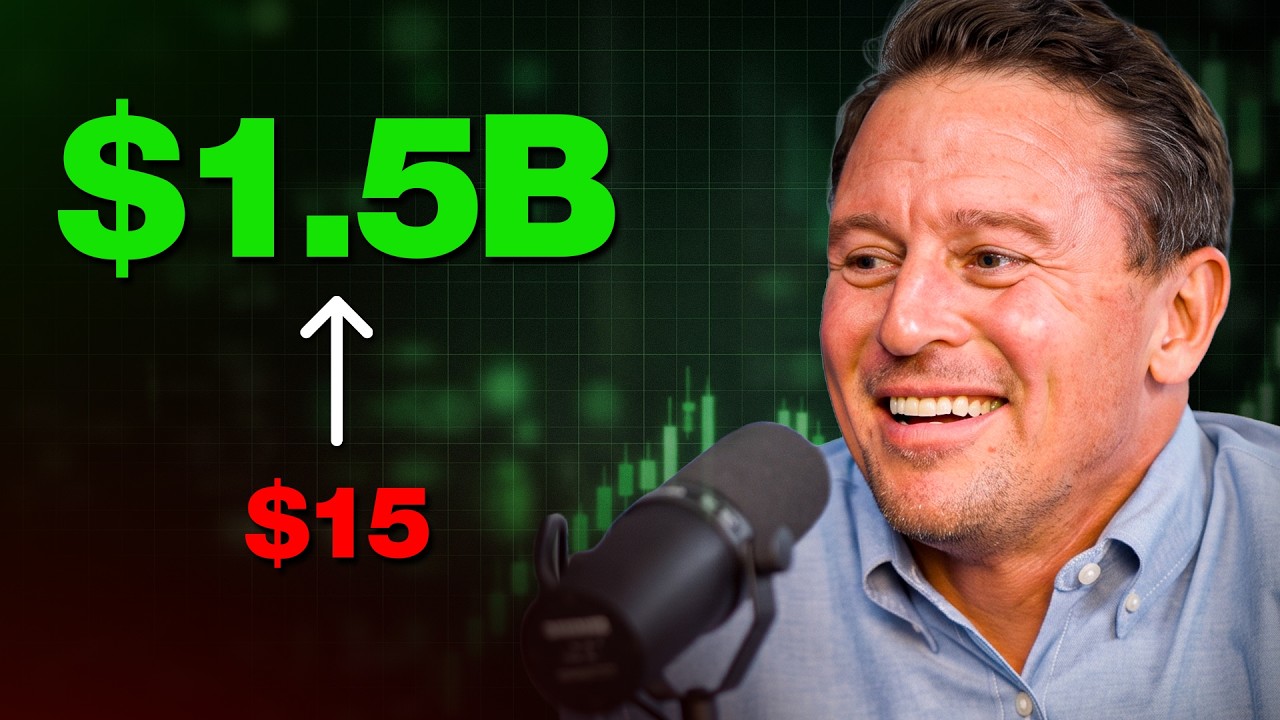
He Sold 4 Companies for $1.5B. The $13M Exit Changed His Life. | Moneywise
David Royce built and sold four pest control companies — for $13M, $30M, $135M, and ~$1.5B. He shares the asset deal strategy, his full investment breakdown, and why he is giving it all to charity.

David Royce built and sold four pest control companies over roughly two decades — Moxie, EcoFirst, Alterra, and Aptive — each one bigger than the last. The first exit was $13 million. The last was in the range of $1.5 billion. He personally took home hundreds of millions of dollars. But the sale that changed his life the most? The very first one.
Like all Moneywise episodes, David breaks down his net worth, income, portfolio, and monthly expenses and then I, your humble host, pick it all apart.
We also went deep on: how David structured four asset deals with no outside investors, his full investment breakdown including three rounds into Anthropic, why he keeps a four-year cash buffer, why he's giving all his money to charity instead of his kids, and the story of how his wealth helped him save his father's life
Below you'll find my summary of the episode along with the entire transcript.
And by the way...this podcast, the concept of it came from Hampton. Hampton is a private, highly vetted community for high net worth founders started by Sam Parr. Members range from companies doing 3-5 million in revenue all the way up to hundreds of millions. The reason we started this podcast is because there are amazing conversations about money and growing companies that typically happen only behind closed doors, and we thought it would be awesome to share all of this information. If you're a CEO, founder, or business owner, check this out. New Moneywise episodes come out weekly.
Listen to this episode on:
Now, below are the notes and the full transcript.
The Numbers
- $13 million — first exit (Moxie Pest Control, sold to Terminix)
- $30 million — second exit (EcoFirst, sold to Terminix)
- $135 million — third exit (Alterra)
- ~$1.5 billion — fourth exit (Aptive, doing $508 million/year in revenue at time of sale)
- 25% — equity given to all Aptive employees (a nine-figure total payout)
- ~$600 million — estimated personal take-home from the Aptive exit alone
- 4 years — cash buffer in fixed income for recession protection
- 50% — portfolio in S&P 500 (with tax-loss harvesting)
- 3 investments in Anthropic through Iconic (a firm that manages money for tech founders including Zuckerberg, Dorsey, and Hoffman)
- $0 — the amount he plans to leave his children (everything goes to charity)
From $0 in Sales to Top Rookie in One Summer
David's journey started the way a lot of great business stories do — broke in college, looking for a way to make money. A friend told him he made $25,000 selling pest control door-to-door over a summer. David signed up.
The problem? He sold zero for five straight days while everyone around him was closing one to four deals daily.
"I bought half a dozen sales books. Zig Ziglar, Tom Hopkins, Brian Tracy. I committed to reading 90 minutes every day no matter what. I told myself, if my friends can do it, I can figure it out."
By the end of that summer, he made $35,000 (roughly $70K in today's dollars) and was the top sales rookie out of 200 reps. A few years later, while still in college, he was earning $225,000 a year from recruiting and training commissions.
When he told his boss he wanted to leave for Wall Street, the response changed his life: "Why on earth would you go work for somebody else?" His boss then told David he was selling his own pest control company to Terminix for $10 million — and suddenly investment banking didn't look so appealing.
The Asset Deal Strategy: Building and Selling the Same Business Four Times
David didn't build one company to the moon. He built essentially the same company four times, and sold each one bigger than the last. His secret: asset deals.
"I sold the customers along with the technicians. Terminix said, 'You can keep the sales thing — the door-to-door stuff seems hard. You can keep a key person in each location too.' So I kept the whole sales organization and started over with a new name."
Same executive team. Same training manual. Same best practices. Same salespeople. New name, new technicians, and more capital to scale faster each time.
"I was either going to have to slow-growth it, or I could sell the business and use that capital to throw into the next one. I didn't have to go get investors. I didn't have to waste time raising money. I kept all the equity. I kept all the control."
When competitors were giving up 90% of their equity to VCs, David owned 100% of his first three companies. For Aptive, he chose to give 25% to employees — not investors.
Silicon Valley Playbook, Applied to Pest Control
With each exit, David reinvested heavily into culture. He visited headquarters at Google, Meta, Nike, and Zappos, then brought those ideas into a pest control company. Nobody had done it before.
"We had an NCAA basketball court, a golf simulator, a movie room, ping pong, foosball, pool tables. We had a suite at the NBA arena where 35 team members could go to every game. Most people who walked into our office thought it was a tech company."
The strategy wasn't just about perks — it was about scaling to 34 states across 5,000 cities. To attract talent at that level, you need a company people want to be part of.
"I just kept taking pages out of the Silicon Valley playbook and applying it to myself. And I couldn't have done that if I had to go get investors."
The Investment Playbook: A Four-Year Buffer and Three Bets on Anthropic
David thinks about his wealth like an endowment, not a retirement fund. His approach is built around one core insight: during the Great Recession, the stock market took three and a half years to recover.
"I take four years of what I absolutely need and put it in fixed income. Everything else, I let it ride. Half in the S&P 500 with tax-loss harvesting, and the rest in alternatives — private equity, direct investments, real estate, private debt."
His key move: accessing world-class deal flow through Iconic, a San Francisco firm originally built to manage money for tech founders like Mark Zuckerberg, Jack Dorsey, and Reid Hoffman.
"They combine all our minds and all our money to get investments into stuff that's really hard to get access to. I've invested three different times into Anthropic in the last year and a half. It's been amazing. But you need the access."
His philosophy is simple: he doesn't want another job. He doesn't want to run a family office. He wants the best managers investing his money so he can focus on his sabbatical and his family.
"The Real Answer Is Just a Little More"
At a board meeting, a fellow entrepreneur asked the room: "What's your number?" Everyone gave an answer — the house in Aspen, the beach house, the car collection. Then the questioner revealed it was rhetorical.
"He says, 'Guys, you're all wrong. The real answer is just a little more.' And everybody went quiet. Because it's true. Whatever you have, you think it's solid, and then over time you want this, or you want that."
David experienced this firsthand through four exits. After the $13 million sale: "Maybe." After $30 million: "Probably." After $135 million: "What was I thinking before?"
"If you think the end is going to be the best thing, the summit is going to disappoint a lot of people. You're kind of stuck with yourself, and you're going to realize it probably didn't solve every problem you thought it was going to solve."
For David, what matters most isn't the money — it's the character, discipline, and expertise built along the way.
Why He Won't Leave a Dime to His Kids
Despite being worth hundreds of millions, David plans to give everything to charity when he dies. Not a penny to his children.
"I plan on giving it all away to charity. I really want them to find purpose in life. I want them to go out, work hard, have incentive to work hard. I've seen a lot of people struggle when they have a lot."
He'll cover their college and grad school, but that's where it stops. The real advantage, he says, isn't cash — it's access to mentorship, connections, and parents who've been through it.
His charitable focus? Education for low-income students — a cause shaped by his own years of scraping by in college, working part-time at a snowboard shop and then McDonald's.
"I almost want to fake a bankruptcy in high school so they understand it's okay to go back to literally nothing." It's a line that gets a laugh, but the philosophy behind it is dead serious.
When Money Saved His Father's Life
The most powerful moment of the episode comes when David talks about his father. Hospitalized in New Orleans with severe bowel stoppages, the doctors couldn't figure it out. Their recommendation: hospice. Go home and die.
"He literally looks like he's been in a Nazi concentration camp. His arms are so skinny, his stomach is the size of a beach ball. You can see death in his eyes."
David called his YPO WhatsApp group — 160 CEOs — and asked one question: "Does anybody have the number of the CEO of Cedars-Sinai?" Within ten minutes, he had it. The head of surgery called back that afternoon.
"She says, 'Have they tried this?' No. 'Have they tried this?' No. 'Have they tried this?' Nothing."
David looked at his father and asked if he'd get on a private jet to LA. The doctors warned he might die on the plane. David's response: "You're telling me he's going to die if we send him home, so I'd rather have him die on the plane trying to save him."
They arrived at 2 AM. Within half an hour, Cedars-Sinai was draining his stomach and had a solution. He recovered within a week.
"It's one of the additional benefits of having money. It can really help you."
Building Leaders, Not Followers
When asked how he wants to be remembered, David doesn't talk about exits or net worth. He talks about training salespeople and developing leaders.
"We would videotape salespeople, throw it up on the big screen, and critique it together. 'When you see something you like, tell me. When you see something to improve, press pause.' I've done this with literally thousands of people, and it changed their lives."
At Aptive, he gave 25% of the company to all employees. When the exit came, people called him to say they'd bought their parents a car, paid off their student loans, or wiped out their mortgage.
"One of my favorite quotes is from Gandhi: 'The sign of a good leader is not how many followers you have, but how many leaders one creates.'"
For David, that's the legacy. Not the $1.5 billion exit, but the thousands of people he helped build careers — and the leaders who emerged along the way.
Other Key Quotes
"Most people think the Aptive sale was the amazing one and the life-changing one. It wasn't. The one that was life-changing was the first one — because when you're going from having basically nothing and then suddenly you have thirteen million dollars come in, the idea of millions of dollars is just wildly different."
"I was either going to have to slow-growth it, or I could sell the business and use that capital to throw into the next one. The secret to my success was really these asset deals."
"I almost went bankrupt the first year. I learned that you could be killing it and dying at the same time."
"I just kept taking pages out of the Silicon Valley playbook and applying it to pest control. And I couldn't have done that if I had to go get investors."
"The real answer is just a little more. Whatever you have, you think it's solid, and then over time you want this, or you want that."
"The thing you really get out of entrepreneurship isn't so much the money. It's the character you build. It's the discipline. It's the expertise."
"I remember thinking McDonald's probably made me hundreds of millions of dollars. You never know where you're gonna get that experience."
"The sign of a good leader is not how many followers you have, but how many leaders one creates."
Links You Might Like
- Join Hampton Community: https://joinhampton.com
- Join Hampton Community
- Daily Body Coach (Episode Sponsor)
- MoneyWise Podcast: Full episode archive
Full Transcript
Guest: Most people think that the Aptive sale was the, the amazing one and the life-changing one. It wasn't. The one that was life-changing was the first one because when you're going from, you know, having basically nothing 'cause you've invested everything into your business, and then suddenly you have thirteen million dollars come in-
Daniel Berk: My guest today is David Royce. He built four pest control companies which were all in the same industry, but each one that he sold was bigger than the last. The first exit was thirteen million, and the last was hundreds of millions personally, sold for one point five billion ...
Guest: real answer is just a little more. 'Cause whatever you have, you think it's solid, and then over time you're like, "Well, I want, I want this," or, "I want that." And-
Daniel Berk: David has hit four different versions of that number. The idea that the baseline sense of enough keeps moving up no matter how much we accumulate.
Guest: If you think that the end, like the, the end is gonna be the best thing or having a big exit, I think this summit's gonna disappoint a lot of people 'cause then you're, you're kind of stuck with yourself, and you're gonna realize it probably didn't solve every problem you thought it was gonna solve.
Daniel Berk: In this episode, David walks through every exit, which includes the exact mechanics of how he structured the sales, what he actually took home after taxes, why he kept restarting instead of just building one and taking that to the moon, his full portfolio breakdown, including where he puts some of his private investments, uh, and then we get to some emotional stuff, like his father almost dying in a New Orleans hospital and what he was able to do because of the money he had for his dad. This is Money Wise. I'm Daniel Burke. Here's David. The first question I'll ask, um, really about the four companies you've sold. I would love to understand what companies you've built and why you ended up selling them, and if you could kind of walk me through those exits, what that looked like for you personally. And then also tell me about the numbers. What did you actually personally make from those different companies?
Guest: Yeah, so the first company was, uh, it was a lot of, like, d- in a, being in a lab and just learning what was working and what wasn't working. I'd, you know, sold pest control before, uh, services, you know, door to door, but I had not actually run a pest control s- uh, operation. So did that for four years, and one of the reasons I sold, I, I realized that money was really important. In fact, I almost bankrupt the company the first year that I started. I learned that you could be killing it and dying at the same time. Part of it had to do with the way we were paying out sales commissions. We paid more of the sales commissions up front than what was actually coming in.
Daniel Berk: Sure.
Guest: And so it was just a cash flow issue, luckily. We were doing so good that we were actually, you know, hurting. And so I had to convince a few salespeople to take their commissions a, a month or two out if I paid them ten percent interest on their money. That's how we got through those tough times. But I realized that cash was king. That was the key to be able to grow, and I was either gonna have to slow growth it, or I could sell the business or a portion of the business off and then use that capital to throw into the next one. So what I did is I went to, uh, Terminix. They're the l- largest pest control company in the United States. And they a- they actually asked me, they said, "You know, can we buy just the customers, uh, along with the technicians? Uh, you know, we don't really... we don't know the sales thing that you're doing. The door-to-door thing seems really hard to do. You can keep that if you want. You know, if you wanna keep a key person in each location, that's fine too." And so basically I sold the first one. I had NDAs, but Forbes, uh, I quote Forbes, they said I sold the first one for thirteen million.
Guest: So now instead of the three hundred thousand dollars I'd saved throughout college, uh, you know, through my sales, uh, commissions, instead of starting with three hundred thousand, now I had, you know, millions of dollars to be able to throw into the next one. The next, uh, and the next one was EcoFirst. That one was build. Uh, it went to four different states initially, and it was like, can we keep it together? Uh, you know, we really had focused on just learning how to build a model with the first one, with the first company. The second company was, can you actually scale? You know, can you find great people to do it the way we did it previously-
Daniel Berk: Yeah
Guest: ... in Southern California? And then, uh, four years, you know, roughly three or four years later, sold it again to Terminix, but only sold off the assets. So the secret to my success was really these asset deals I was doing. And it's not completely unique to pest control services. I've seen it done, uh, with alarm systems. I've seen it done, um, with other c- other companies, so- solar. And I basically did that, uh, sold that one for, Forbes said thirty million. Did another company, Alterra-
Daniel Berk: Money Wise is a show we started because there's a lot of people we talk to in the Hampton community who have built and sold companies who are navigating exactly the types of questions that David is answering for us right now: how to structure a sale, what to do when the wire hits, how to actually think about the money after. And what I love about Hampton is that these conversations happen in private all the time. I just get to pull them out into the open. If you're running a business with at least three million in revenue, it might be worth checking out. You can find it at joinhampton.com. And when, when Forbes says thirty million, thirteen million, how far off are they? I know y- you're under NDA. I mean, we're talking-
Guest: They're pretty close.
Daniel Berk: Yeah.
Guest: Pretty close. Okay, cool. They're pretty close, yeah. Uh, they said I sold Alterra for a hundred and thirty-five million. So it's like, I just kept getting money, and what's the beautiful thing about this is I didn't have to go get investors. I didn't have to waste time trying to raise money. Um, I was able to keep all the equity. I was able to keep all the control. And so a lo- a lot of huge benefits to this, so I'd highly recommend other people think about it as they're building a business because, you know, for so many groups, when they go out and get venture money, you know, they, they gotta raise money. It takes away time-
Daniel Berk: Yeah
Guest: ... from the business, and then they're, uh, you know, giving up equity after equity. And so a lot of times they finish and they only have ten percent equity in the company left. You know, I was able to, I was able to have a hundred.
Daniel Berk: Wow.
Guest: On the last business for Aptive, it was a little different. I, I wanted to give away a big portion of the company to our employees, so we give twenty-five percent of the company away to them. Um, I gave-
Daniel Berk: Wow
Guest: ... a big portion of the company away also to my, uh, my CEO, and I stepped back as chairman, uh, to really just focus on strategy and not have to be as involved in the day-to-day. I was doing, you know, eighty-plus hour weeks for many, many years prior to that, and I was ready to step back as I started to have my family. And that one, I can't say how much we sold it for, again, 'cause of the NDA. But, uh, we were doing five hundred and eight million a year when we sold it.
Daniel Berk: Wow.
Guest: And, uh, a typical pest control company sells anywhere between, it can sell for as low as one times revenue up to three times revenues.
Daniel Berk: Okay.
Guest: So I'll let you do the math.
Daniel Berk: So, so l- let's, let's call it one point five billion, and we can use that range. Is that, uh... Would you say that's accurate for-
Guest: Um, yeah. Yeah, that's a one point five good range.
Daniel Berk: Okay, cool. And so you had Moxie, right? SoCal, that's the thirteen million. That's number one that sold.
Guest: That's right.
Daniel Berk: Uh, really that was kind of your, your leap into entrepreneurship from being a salesperson. Then you had EcoFirst, let's call it thirty million. Then you had Altera for a hundred thirty-five million, give or take, and then let's say one point five billion for Aptive. What did you actually take home? And you can provide ranges with these too, but obviously the mechanics of a sale at the thirteen million and the one point five billion, those look very different, and you even mentioned twenty-five percent given away to your employees-
Guest: Yeah
Daniel Berk: ... with the last sale. What did you personally see in cash from those take homes or from those sales?
Guest: Yeah, I can't give the exact numbers but, you know, basically for the first three companies I owned the majority of all those companies, right? Uh, I didn't have to go get investors. My first company, my original... my previous boss, he did invest into the company. I think he had twenty or thirty percent of the business at that time. Uh, but he was a silent investor. He was just like the money. And really the reason I got him is 'cause I wanted to be able to put in a phone call. If I had a, a question about anything, it was just, it was nice. You know, I could call him once a month and be like, "Hey, what do you think about this or about that?" Um, so yeah, for the, each company I guess you could think about, you know, taxes, you gotta pay cap gains.
Daniel Berk: Mm-hmm.
Guest: So maybe you take away a third, especially if you're living in California or whatever. Uh, and then for the, for the last business, you know, I'll just say, you know, hundreds of millions.
Daniel Berk: Yeah.
Guest: Uh, which I, it was, was very easy to say. Same thing for all of our people. If you give away twenty-five percent of the company and it's in that ranges, you know, those ranges we spoke about, you know, I can easily say that we gave away a nine-digit number and we had a lot of people make six and seven figures on the exit-
Daniel Berk: Wow
Guest: ... which would, felt really, really good.
Daniel Berk: That's incredible. And so you made hundreds of millions. W- Talking two hundred million or closer to nine hundred million?
Guest: Uh, close... Yeah, I mean, somewhere in the middle there.
Daniel Berk: Okay. Okay. Let's, let's go with maybe six- six hundred million on the last sale. Where does that leave your current net worth today with those four acquisitions?
Guest: I can't say exact net worth just 'cause I, I'm probably pushing a little bit too close to, uh, you know, disclosing how much I made if people did it b- do the math backwards and figured it out. But, you know, just, just say, let's say hundreds of millions of dollars.
Daniel Berk: Okay. Yeah, fair enough. Where does that money sit if you're, if you're looking at your full portfolio? Are you investing in other companies right now? I know you mentioned now you're on a well-deserved sabbatical, and so, you know, what, what's your money doing right now while it kinda just sits there and while you're soaking in a well-deserved twenty-five-year vacation?
Guest: But before I sold, I really thought... I put a lot of thought into this about, you know, how, how do you become an investor? You know, it's kind of like the final stage for a lot of entrepreneurs. You know, you go across your life, you build something, and the goal is to be able to have your money make money for you, so you don't ever have to work again, right? This financial independence. So the way I think about it, because I have so much, I think of it a little bit more like an endowment, right? It's like I don't necessarily need the majority of that money. If I was, uh, you know, a, a individual who had retired, you know, and was living on some sort of a pension or something else, you would need to make sure that money was really secure, and so you might do like a traditional sixty/forty portfolio, sixty percent equities or forty percent fixed income, whatever. I don't think of it like that. I, what I do is I take four years of what I absolutely need.
Guest: So if we had another great recession like we did in two thousand eight, I've got four years of money to get through that. 'Cause I know it took three and a half years for the stock market to come all the way back to where it was-
Daniel Berk: Mm-hmm
Guest: ... previously. So I can live just off that money, and I'll put that money in fixed income, you know, something that's secure. But everything else-
Daniel Berk: So like I'm talking CD, savings account? What does that secure look like for four years?
Guest: Yeah, just a mix of different fixed income. It doesn't have to be CDs.
Daniel Berk: Okay.
Guest: You know, I, I wanna make some money off of what I-
Daniel Berk: Yeah, right. Of course
Guest: ... what I've got, right? Um-
Daniel Berk: Yep
Guest: ... but my, my, my thought is I'm gonna let it ride. Like, so I've got half of my money in stocks, uh, you know, like S&P five hundred, but, you know, with the tax loss harvesting strategy so I can get a little bit of extra return off the, uh, the tax savings. And then on everything else, I'm in alternatives. So it's like everything from private equity to direct investments to real estate, private debt, uh, that sort of a thing.
Daniel Berk: Okay.
Guest: And, you know, I do have, I do have, um, my philosophy, I don't really want another job myself personally.
Daniel Berk: Yeah.
Guest: I, I have a lot of friends where they've, you know, started up their own family offices, and they're doing a lot of the investments just in-house themselves. They've actually hired people.
Daniel Berk: Mm-hmm.
Guest: And so my, my philosophy on it right now is how do you get access to the very best investments? So, uh, I researched probably three dozen different firms, and I, I found this group Iconic, who I love, out of San Francisco. And it's, uh, some of the guys that originally managed Mark Zuckerberg's money, uh, Jack Dorsey's money, Reid Hoffman's money. Uh, there's a bunch of just your tech founders that are up there. And what they do is combine with all of our minds and all of our money. They get investments into stuff that's really hard to get access to, you know, that is, you know, prior to, you know, companies going public. So like I just invested in Anthropic, uh, well, last year and a half I've invested three different times into Anthropic.
Daniel Berk: There you go.
Guest: Yeah. And it's been amazing, right?
Daniel Berk: Yep.
Guest: But in order to do that, I had to have the access.
Daniel Berk: Yeah.
Guest: And so for me, going through the right firm was key to be able to find that. Now, if you had billions and billions of dollars like, uh, you know, maybe Mark Zuckerberg, you know, his people in-house might be able to just, you know, contact them directly and, and get that from him.
Daniel Berk: Yeah. I have a friend who was early, by invite only, to SpaceX, who is-
Guest: ... you know, awaiting a nine-figure payout here in the next few weeks, and so I think access to those investment portfolios is, is huge. Uh, it, it does, doesn't surprise me that you're looking for that as a priority. When you talk about S&P 500 and four years savings, some of the different breakdown in real estate, what's the actual amount you're putting in those different strategies? And, and then walk me through the strategy a little bit more. I think the listeners hearing this who might, you know, resonate a little bit with your portfolio are wondering, you know, why does he put the 60/40? Why, why is he, you know, saving four years instead of five or instead of one? Um, and they would wonder, you know, what those actual amounts are.
Guest: Yeah. So depending upon how much money you're going to spend per year, you gotta know whatever that is, right, to cover your annual expenses. And the reason I do that is because I'm putting so much into alternatives and the stock market. Now, if we have a great recession or a really, you know, bad depression or something, on average, you know, the market's gonna come back... The average recession comes back at about a year and a half, or the stock market comes back about a year and a half.
Guest: Uh, the Great Recession lasted three and a half years, so my philosophy is for four years I gotta have m- money, so that way I'm not taking money out of stocks when the market has maybe gone down, let's call it 20 or 40 or 50%. Right? You gotta just let it go. I, I will never, ever take my money out of the stock market when we are down. So that's why I've got the money off to the side-
Daniel Berk: Yeah ...
Guest: just so it's, it's prepared for, you know, that rainy day.
Daniel Berk: Okay. And as far as the real estate-
Guest: And the fixed income goes like-
Daniel Berk: Yeah. Go ahead ...
Guest: you know, for s- for the average investor, you know, say you're retiring and you've got, you know, some money in the bank, you know, you've gotta be able to survive every month. You're making a certain amount. And so, uh, typically you need something that's more steady. And so if you mix more fixed income into that, uh, the... For the most part, s- uh, stocks and fixed income, they are, I think, 80%. They're in an inverse relationship, right?
Daniel Berk: Mm-hmm.
Guest: So 80% of the time, stock goes up, you know, uh, fixed income's down, or vice versa.
Daniel Berk: Yeah.
Guest: Every once in a while they both go down, and everyone's like, "No."
Daniel Berk: Yeah.
Guest: But, you know, it is, it is what it is. And so that's-
Daniel Berk: Mm-hmm ...
Guest: that would be the safe way to do it if you didn't pa- if, if, if you were like most average investors. Most people think that the Apto sale was the, the amazing one and the life-changing one. It wasn't. The one that was life-changing was the first one because when you're going from, you know, having basically nothing 'cause you've invested everything into your business, and then suddenly you have $13 million come in, like, you know, most people in their minds, the idea of millions of dollars is just wild, wildly different, right? And it is.
Daniel Berk: Mm-hmm.
Guest: It's so different from how I lived previously, scraping by in college and living in a o- I was in a one-bedroom apartment, you know, when I sold the business. Uh-
Daniel Berk: That's crazy.
Guest: So to me, that's, that was the most exciting. You know, a- as time goes on and because I had sold multiple businesses, I would sell them, and I would take a lot of it and put it back, but I wouldn't take everything and put it back. But I would, you know, use that into my life- uh, to build my lifestyle and to invest and, um, you know, diversify a little bit outside of business.
Daniel Berk: Yeah. And, I mean, did your lifestyle change much when you went from, let's say, no money and then now you're a millionaire overnight? I mean, what did that lifestyle change look like? Or did it change at all?
Guest: So you're gonna laugh. Um, it actually, it didn't change that much, mainly because I was gonna do it again. I knew I was gonna roll the majority of that money back into the business, or into the next business. The easiest way is to think about it like the same organization. It was really-
Daniel Berk: Yeah ...
Guest: the same organization, but the only thing we had to do was take off the name and start up with a different name. And then we did have to hire all new technicians, but all the salespeople were the same. Key operators in each location were the same. Executive team was the same. Same training manual, same, you know, best practices, all that sort of thing. And we just get better and better, but we can level up with each company.
Daniel Berk: Yeah. Right?
Guest: So, like for example, when we went from Eco-First to Altera, we had a bunch of extra money. I'm like, "Okay, well, what can we do, you know, to attract the right talent?" So I started studying companies like Google and Meta and, you know, uh, I went to the Nike headquarters and Zappos headquarters. We went... I went to a ton of headquarters and just took all their best ideas and thought, "Well, why don't we apply this to pest control?" It's never been done before-
Daniel Berk: Yeah ...
Guest: but it'll make it a lot more interesting, and if I really wanna grow into... We're in 34 states across 5,000 cities.
Guest: The idea is if we're gonna try to get to that stage, we've gotta attract the right talent, so let's make it really cool and different, exciting. And we, we had an NCAA basketball court and a golf simulator and a, a movie room, ping pong, foosball, you know, pool tables, all, all those kinds of things. Uh, we had a suite at the, uh, NBA arena, you know, that we could go to with, you know, 35 of our team members, you know, every game. So we just kept trying to think of things like, "How do you make it interesting?" And most people, when they walked into our office, they thought it was a tech company. You know? Wow. They had, had no idea it was pest control. But they could tell that it was a cool company culture and that it was unique and different and then, you know, giving pe- allowing people also to have equity in the company. I just kept taking pages out of the Silicon Valley playbook-
Daniel Berk: Sure
Guest: ... and apply it to myself, and I couldn't have done that if I had to go get investors. Uh, just wouldn't have been possible.
Daniel Berk: Why pest control? I, I look at these four companies, and it looks like you built the same company four times. Basically different names, same strategy, same product more or less.
Guest: Yep.
Daniel Berk: Walk me through what in your life caused this idea of, "Let me start a pest control business portfolio over the next 25 years."
Guest: Yeah, so it all goes back to college. I'm a starving student, you know, working at a snowboard shop part-time-
Daniel Berk: Nice
Guest: ... trying to pay my way through school. And I had a friend come to me and go, "Hey, I made 25 grand last summer, you know, in about three and a half months, you know, do, uh, selling pest control door-to-door. You know, do you wanna go with us?" Yeah, and he's like, "Yeah, it's really cool. You know, we go surf on the weekends and, you know, with a bunch of guys." And, uh, I didn't hear anything he said. It was just the 25 grand. I'm like, "Yeah, man, whatever that is." I'm gonna go do that, 'cause minimum wage at the snowboard shop wasn't huge.
Daniel Berk: Sure.
Guest: Yeah. Wasn't, wasn't great. So I, I get out to, uh, it was in Sacramento, California is where we went. Uh, we were originally gonna go to San Francisco, ended up in San, uh, Sacramento. And I get there, and I've got a problem. I suck at sales apparently.
Daniel Berk: Oh, no.
Guest: Uh, I sell zero for five days straight, and my-
Daniel Berk: Awesome
Guest: ... other friends around me are selling one to four sales every day. And so I'm going, "Oh, man, uh, do I need to go home? Like-
Daniel Berk: Sure
Guest: ... did I make a mistake coming out here?" But I'd already got an apartment, and I'm like, "Okay, I know this is the very best thing I can do with my life right now. It's the best opportunity." And the beautiful thing about sales and commissions, right? It was on a commission only, so I was making zero money that first week.
Daniel Berk: Yep.
Guest: I was only getting free cardio out of it. The, the beautiful thing about commissions is if you improve yourself, if you learn, you can make more, right?
Daniel Berk: Mm-hmm.
Guest: 'Cause you learn how to sell better, and you're willing... If you're willing to put in more hours, all that sort of thing, it, it can be amazing. I went out and I, I bought, uh, half a dozen sales books. You know, a lot of the old classic guys like Zig Ziglar and Tom Hopkins, Brian Tracy.
Daniel Berk: Yeah.
Guest: And I s- I said, "I'm, I'm committing myself to reading 90 minutes every day. No matter what happens, I'm just gonna keep studying, and if I have to stay here all summer and not make any sales, that's what I'll do." But I just felt like, look, I'm confident in myself. Eventually, I'm gonna figure this out. If my friends can do it, I can figure it out. And pretty quickly, I started to sell, and by the end of that summer, I made 35 grand, which if, you know, in today's money, that's like double in today's money, so call it 70 grand.
Daniel Berk: Yeah.
Guest: And, uh, yeah, I, I was, I was the top sales rookie out of like 200 reps.
Daniel Berk: All right, Money Wise listeners, quick reality check.
Daniel Berk: It's that time of year when you catch yourself thinking, "Why didn't I start earlier?" We knew summer was coming. It always does. And if you keep doing what you usually do, you'll blink, and it'll be New Year's again. Same story, same body, same excuses. That's why today's sponsor is Daily Body Coach. Daily Body Coach is a premium online coaching service for ambitious entrepreneurs and executives who want their body to perform at the same level as their business. Training is built around your schedule. Nutrition is built around your specific needs. There are clear targets and clear metrics. And most importantly, there's no guesswork, just science and a multidisciplinary team covering training, nutrition, and the psychology behind behavior change. Daily Body Coach is run by Anthony Monica, who's a Hampton member himself, and in fact, a bunch of other Hampton members are using it and have been showing great results. Yes, you'll look better this summer, leaner, stronger, sharper. But the real win is that you'll stop carrying a body that's taxing your energy, confidence, and longevity. If you're serious about fat loss, muscle gain, and building a body that supports your standards, don't think about it, don't bookmark it, don't push it to Monday. Click the link in the description and I'll hook you up with Anthony directly. Check out dailybodycoach.com/moneywise. That's dailybodycoach.com/moneywise.
Guest: So where I'm going with this is I, I springboarded off that into the next thing. Uh, I went to work for a startup the next year. I was working at a big $100 million regional pest control company that first year. The second company, I worked for a startup. They only had two locations, and when I got there, there was no training at all. And so I asked the, my boss, I said, "Hey, do you mind if I write a training manual? I brought some of my friends out. I want them to do really well." And he's like, "Yeah, that'd be amazing." And by the end of that summer, we had sold twice as many as his other location. And so he pulled me aside and said, "Look, I'd love for you to recruit for my company and oversee-
Daniel Berk: Wow
Guest: ... all the training so I don't have to do it, and I'll pay you a cut, a big commission off everybody." And so I did that for the next, uh, let's see. I did it over three years, and by the time I was about to graduate, I was making 225 grand back then.
Daniel Berk: That's awesome.
Guest: Yeah.
Daniel Berk: That's great.
Guest: And it, it was when I went to my boss and I s- I said, "Hey, I need a letter of recommendation from you for what I wanna do after college. I'm gonna graduate. I'm studying finance. I'm gonna go into investment banking. I've gone out to New York. I wanna do M&A. You know, I've got a sales background and I've done finance." And he looks at me and he just asked the question, and this goes back to your original question. He goes, "What on earth... Why on earth would you go work for somebody else? Like, you're like top 1% of 1% in sales on what you've done. Like, you're overseeing 100 people that you've recruited, trained, managed. Like, you're clearly capable. You should go start your own company."
Daniel Berk: Yeah.
Guest: And my answer to him, which is probably embarrassing now, was, "Yeah, it's not very impressive." You know? I've just... I've, I've studied finance. You know, pest control-
Daniel Berk: Yeah
Guest: ... is not very sophisticated. And then he told me, he says, "You know, I'm, I'm actually selling my company, uh, to Terminix, and I'm selling it for 10 million bucks." And he was kind of like, "Does that change your mind at all?" And I'm like-
Daniel Berk: Probably
Guest: ... "Hmm, maybe."
Daniel Berk: Yeah.
Guest: Yeah. And I knew he'd o- I knew he'd only put in a few hundred thousand dollars into the business, and I'm like, in four years, he turned that into 10 million bucks? It still took me a couple months to come around to the realization that that made sense, and that I should probably go for the opportunity-
Daniel Berk: Yeah
Guest: ... as opposed to, you know, whatever the prestige would have been in investment banking.
Guest: And so that's how I fell into it. You know, total accidental entrepreneur. Wasn't what I originally planned to do. It's probably not what anybody plans to do, uh, originally. Like no- most people aren't thinking about pest control when they're going to college.
Daniel Berk: That's so crazy. And when I, I mean, when I look at your story, it doesn't look like someone who fell into entrepreneurship. It, it looks like someone who had a grand plan of how they would build and sell companies. And I think when people look at that, I, I imagine some people wonder why do four of these instead of just one to, you know, the nth power. So, so walk me through that thinking. Why not just build one and get a meaningful exit equal to what the four together became?
Guest: So with the, the first one, when I sold it, it, it was... That first year, right, I almost went bankrupt.
Daniel Berk: Mm.
Guest: And so that was the thing that scared me, and I thought- Yeah, uh, number one, I don't wanna ever get close to that again. Number two, if I wanna grow really fast, I have the capability to recruit more. Like, we were, we were doing really, really well, but I was having to put the brakes on intentionally to not go bankrupt. Uh, and I just kind of said, "Look, I can either grow really slow over time, but that's just not fun. It just isn't who I am." Like, I always love growth.
Daniel Berk: Mm-hmm.
Guest: I love being top 1% of 1%. I love getting on my sales teams to be top 1% of 1%. And so entrepreneurship, it actually became kind of a natural extension of that. It was really like a step-by-step process, right? You get to one point, and you can see more of, "Hey, we could do this." And then you get to here, and you're like, "Well, I can now, now standing here, I can see this. We can go do this." So the first company, it was learning how to initially run the business, create best practices, is you gotta nail it before you scale it, right? Selling it gave me the capital to then go, "Why don't we go try it in different states, see if we can manage that?" When I got into different states, it, it-- we were going through the Great Recession at that time, and so we got really, really tight with our, our money, and we were very, very strict, which is great for an entre- uh, you know, entrepreneurial venture.
Daniel Berk: Mm-hmm.
Guest: And so when I sold that one and we were starting in Dalterra, that's when I'm like, "You know what? Let's... You know, times are... We're, we're kinda coming out of this recession thing. Let's really invest in our people. Like, let's, you know, get the head-- crazy amazing headquarters. Let's do these really fun compan- uh, company retreats." Um, we would-- we started off going to places like Hawaii, you know, the Carib- uh, Caribbean.
Daniel Berk: Nice.
Guest: But we're like, you know, we're, we're diving with sharks. We're skydiving. We're, you know, j- jumping off cliffs. It was just like a really fun, wild culture 'cause many of the, uh, you know, salespeople were college students, you know, so they got lots of-
Daniel Berk: Mm-hmm
Guest: ... testosterone and adrenaline, that kind of a thing. Uh, and then just kinda step by step, right? We kept, kept growing it. If, if we had not sold the business or, or if I had sold the business... I remember when I sold the first one, I was talking to different financial advisors, and one of the advisors said, "You know, you can retire now. You don't have to ever work again." And I'm like, "Yeah, but I'm only gonna have this lifestyle if I retire now-
Daniel Berk: Sure
Guest: ... plus I have all this extra time. It just doesn't make any sense." So needless to say, I didn't end up going with that financial advisor.
Daniel Berk: Yeah, yeah.
Guest: But he was really... I mean, he was right in the sense that I could've if I, if I wanted to, but you know, I was ready for the adventure.
Daniel Berk: That guy missed out on hundreds of millions of upside there, didn't he? Goes to show, don't always say what you're thinking, financial advisors. No, just kidding. Um-
Guest: That, that's true ... that's very interesting. That's very interesting.
Daniel Berk: So when you...
Daniel Berk: Y- your response to that one financial advisor was, "Well, my lifestyle is gonna look just like this." So walk me through now, I mean, 20 years removed from that first sale, give or take, how has your lifestyle changed, and what does your actual monthly spend look like in your current lifestyle?
Guest: Man, it's, it's extremely different. So I was so tight when I first started. I mean, we had... Uh, I got married young. I married my college sweetheart.
Daniel Berk: Awesome.
Guest: And we were living in a one-bedroom apartment. She was going to law school at Pepperdine. Well, I'm starting my first company, and I convince her I'm taking everything we have and I'm putting it into the business. Um, and we were lucky she got a, a scholarship, uh, for the majority of her, her law to go through.
Daniel Berk: Yeah.
Guest: And so it's like we literally were like, "Hey, I'm, I'm all in on this," and she trusted me with it, which I'm not sure she should have, to be honest.
Daniel Berk: It sounds like you-
Guest: Uh-
Daniel Berk: ... you both made it out all right, so that's, that's great though.
Guest: Yeah. But you know, we were just super, super thrifty. Uh, we had lots of friends, you know, they started to go to nice dinners. You know, they started to, uh, get nice cars, uh, that kind of thing. Uh, you know, they'll go to college at some point, and they'll, you know, have to, have to live on a much more thrifty lifestyle. Um, and I'm a little different. Like, I actually don't plan on giving my money to my children. I plan on giving it all away to charity.
Daniel Berk: Uh- Wow
Guest: ... and I really want them to find purpose in life. I want them to go out, work hard, have incentive to work hard. I've, I've seen a lot of people, um, struggle when they have a lot. It's 'cause it's almost like this idea, if they're just-- if it's just given to them, how do you appreciate it, right? And also, how do you have the discipline? You know, the discipline I gained through entrepreneurship really gi- gives me a lot of investment discipline now, uh, to make wise decisions, uh, and knowing where to put my money.
Daniel Berk: Yeah.
Guest: So yeah, I, I worry that, you know, it's-- I almost wanna fake a bankruptcy in high school, like when they're in high school-
Daniel Berk: Yeah, yeah
Guest: ... so they understand it's okay to go back to not- to, to literally nothing, go, go live in an apartment, pretend to feel that way. My, uh, my parents really struggled financially wise from the time I was in the fifth grade through the 11th grade. In fact, my mom came to me and said, "I think we're gonna lose the house next month."
Daniel Berk: I have had a lot of these conversations now, and there's almost always a moment where you start to understand why someone built what they built. For David, this is that moment. Fifth grade through 11th grade, six years of watching his family lose almost everything while his dad, a former COO and CEO, tried to hold it together. The formative years, let's call it. I think this is why David sold every single company at the peak instead of holding. Every exit was a way of making sure that feeling could never really come back, and the money was sort of his path to making sure there was a sense of security. What he was really building every single time was security itself. Wow.
Guest: Uh, my dad, my dad was gone five days a week, um, you know, trying to make ends meet. And to be fair, he had, he had been a COO and a CEO of other companies, but when he tried to go take, uh, pieces of other companies, I, I don't think he was spread out across enough companies, and the ones he was in, it, it just didn't go well-
Daniel Berk: Mm-hmm
Guest: ... didn't end up working out. But that, I think that fear in me, it made me wanna have financial control of my life at a very early age, and it made me wanna go get a job when I was 14 at a pizza parlor. You know, I got let go from there after a year. I went and worked at McDonald's for a couple years.
Daniel Berk: Wow.
Guest: And all those things there were lessons in my life of, you know, how to run a business. I saw how mom-and-pop, you know, the pizza place was.
Guest: They only had two locations, and it was You know, they're good people, just no systems. Yeah. And then I went to McDonald's, and totally different world, right? It's like a well-oiled machine, training, uh, you know, best practices for everything. It was, it was incredible. I can't tell you how many times running businesses I thought back, "Okay, what would McDonald's do in this situation?" They literally probably made me hundreds of millions of dollars.
Daniel Berk: Wow.
Guest: And you never know where you're gonna get that experience, right? Or that thought. Like, I never would've thought that was going through it. I was, I was honestly embarrassed by it, like, working for it. But I wanted... You know, I wanted to earn money at a young age so I could afford things that I wanted to purchase myself.
Daniel Berk: Yeah. So now with your kids and thinking of college, and y- you mentioned giving to charity, I mean, what's the breakdown of that personal spending? And are you literally going to give away all of your money before you pass away someday? Or, or what's the, what's the plan?
Guest: Yeah. I t- so w- we give away about a, little by little along the way. I, when I, when I die, I want it to all go to charity at that point. Uh, places I'm looking at right now, it could be United D- Degro College Fund. Somewhere where of, of helping folks where they have, maybe, it look, primarily, uh, if coming from low-income families, right?
Daniel Berk: Mm-hmm.
Guest: They've worked really hard at school. They don't have the financial means. I know what that feels like to be going through college and not have the money and trying to work a part-time job at the same time and, you know, nobody really wants to take on loans if they don't have to.
Daniel Berk: Mm-hmm.
Guest: So just, you know, giving back and providing that opportunity to others. My kids are gonna be fine. Like, I'm gonna take care of all their college for them. Yeah. I'll take care of their grad school. And the biggest advantage I think they've had was us, right? Like-
Daniel Berk: Mm-hmm
Guest: ... the parents. Like, we're right there. If you have a question, you need a mentor, like, we're here for you to... If you wanna be an entrepreneur, a business owner, you wanna go into something else, we know lots of other people that are probably in those fields. We can, you know, maybe set up a meeting or something like that. But they, they gotta go out there and earn it on their own.
Daniel Berk: Yeah. I- I've asked a, a lot of people this question on the show and just in conversations about what we, we call on Money Wise the threshold number, and it's the number where when you hit that number, you really don't feel like you have to make any more money ever again. You're set. And whether or not you choose to make money later, it's all just optional cherry on top. Was that after your first sale, you felt like you were truly okay financially? Or did you feel like that after Altera or Aptiv or somewhere in between? And what, what was that number, if you don't mind sharing the, you know, the threshold number of, "I hit this and I was, I was okay"?
Guest: So that's the funny thing. If you, if you'd asked me then, would I've said it was enough, I would've said, "Yeah, maybe." You know, it's, it's, it's close. Like, for most people, yes. And then when I sold the second one, I probably would've said, "Yeah, it's probably enough." But then you get to the third one, you're like, "That was never enough. What was I thinking?" And then you get to the fourth one and you're like... But so here's, here's the thing, right? It's that hedonic treadmill. Um-
Daniel Berk: Yeah
Guest: ... like, your happiness, we always normalize to whatever we end up doing. We always want the next biggest thing. I remember I was with a bunch of other entrepreneurs, and we were at a board meeting, and we were starting to talk ab- uh, just as, like, an opener, somebody said, "Hey, I'm just kinda curious, what's your guys' number?" It's a little awkward.
Daniel Berk: Uh-
Guest: Yeah
Daniel Berk: ... you know, some guys, most answered it.
Guest: Some guys said, "I don't really feel comfortable talking about it." And but we went around, and everybody says... You know, people are coming up with different reasonings for it. They're like-
Daniel Berk: Yeah ...
Guest: "You know, if I had this, then I can have the house in Aspen, you know, I could have the beach house. I've got my main house. You know, I've got X amount for clothing," or whatever, you know. Uh, "X amount for car collect-" You know, people had all kinds of different ideas.
Daniel Berk: Yeah.
Guest: And then when it got back to him, he, it was actually a rhetorical question. That's not what he wanted to, uh, ask. It was more he wanted to tell everybody something. Everybody have this realization. He says, "Guys, you're all wrong." He says, "The real answer is just a little more."
Daniel Berk: Interesting.
Guest: And everybody's like, "Uh," right? Like, and it's so true because whatever you had, you think it's, it's solid, and then over time you're like, "Well, I want, I want this," or, "I want that." And really, if you just realize that, you know, you're always gonna normalize to whatever that next thing is-
Daniel Berk: Yeah ...
Guest: you can just be happy with yourself, your c- your friends, your partner, your dog, your kids. Like... But I think a lot of us, we, we're, we're constantly searching, maybe in the wrong place, you know, for happiness. Uh, and some of that may come from, you know, trauma from growing up. It may come from just, you know, hearing the wrong things from the wrong people over time. But it is really fun. The thing you really get out of it isn't so much the money. Uh, the thing you get out of entrepreneurship, it's, I think it's, it's the character you build, right?
Daniel Berk: Yeah.
Guest: It's the discipline. It's the expertise. And so if, if you're looking, if you think that the end, like, the, the end is gonna be the best thing or having a big exit, I think the summit's gonna disappoint a lot of people.
Daniel Berk: Yeah.
Guest: 'Cause then you're, you're kinda stuck with yourself, and you're gonna realize it probably didn't solve every problem you thought it was gonna solve.
Daniel Berk: David is exactly the kind of founder whose conversations live inside Hampton. Hampton is a private community for CEOs and founders who've built real businesses. Most Hampton members have already had a meaningful exit, and many are also on their way to one right now, doing at least three million in revenue. This podcast exists because those conversations deserve to be public. If you're running a company with at least three million in revenue or you've already had an exit of 10 million or more, check it out at joinhampton.com. So do you fall into that just a little more category, or was there a time in your journey where you're like, "You know, I, I've, I have enough. I, I really don't need any more from here on out"?
Guest: So what, when I was, when I was thinking about this one, I'm like, "Okay, I've done all the calculations. I know if I invest X, like let's say if I'm gonna make 10%-plus a year on my returns, I'm gonna make tens of millions of dollars a year. I can't... But for me, I, I can't really spend that. It's not worth..." You know. "And so I'm gonna grow this, and we're gonna, you know, grow it even bigger, and then someday I'm gonna give it all away and see how much I can actually give away to charity." Um, so yeah.
Daniel Berk: Wow. I mean, that was my calculation in my head when I sold. That's very cool. Why, why give it all away to charity? Tell me more about your reasoning behind that. And, uh, you know, in my research, it looks like you're a person of faith. Does it have to do with your faith that you're giving it away, or is it more of a just a personal philosophy of being, you know, altruistic or maybe something different?
Guest: You know, I think it's, it's less about faith per se. I, I guess that it- it's almost like I want people to have the same opportunities that I did. I never thought just because you're born into this country, right, you've already won the ovarian lottery.
Guest: I never thought it was fair that people are born with maybe different parents, you know, d- under different circumstances and different financial means. Uh, quite honestly, it was frustrating when I saw somebody at college, and they rolled up, you know, in a brand-new car or something, and then everybody else was, like, really struggling. And it's like, well, like, what is... what are those parents thinking by giving that child that car? Are they trying to make up for what they didn't have as a child, or are they trying to make them feel like they're above everybody? Like, I ne- I never understood it. Like, the happiest times in my life have been probably in college, right? When I'm around everybody else, we all have nothing. We're all focused just on school and having a good time, and it was awesome.
Daniel Berk: Yeah. It's like you don't have to have, like, a super nice car in order to have, you know, happiness. I'd love to know now that you've built and sold companies, and you, you talked a little bit about your parents. Do they know your financial situation? Have you ever talked to them about now what your life looks like and even the success that you've had, and have you shared some of that wealth with them?
Guest: Yeah, to a degree they know. Uh, my mom's passed. She's, she passed about 10 years ago. Um, my dad is barely hanging on. He just went through some major health issues. Um, but it's kinda one of the nice things about having money too. I mean, I... Uh, that's another thing I learned where the quality is not the same is he was, uh... he has a girlfriend down in New Orleans, and he was dating. He's, uh, been with her for a while, and he's down there, and he has, um, some issues, uh, with, like, bowel stoppages and other things. So he goes to the hospital there. They, they could not figure out how to fix it, and so they-
Daniel Berk: Yeah
Guest: ... literally told him, "You need to go on hospice and go home and die." And I put in a call to, uh, I have a group of people here, uh, just about 160 CEOs in my YPO, uh, WhatsApp chain.
Daniel Berk: Yeah. Yeah.
Guest: And I just said, "Hey, does anybody have the number of the CEO of, uh, Cedars-Sinai?" And someone within 10 minutes sends me the link and says, "Hey, here it is."
Daniel Berk: Wow.
Guest: And I said, "Here's all, here's what all the symptoms are. Here's the issues. What should we do? Any, any ideas?" And he says, "I'm gonna have my head of surgery contact you, uh, this afternoon when she's done with surgery." I fly to New Orleans, uh-
Daniel Berk: Wow
Guest: ... to see my dad. He literally looks like he's been in a Nazi concentration camp. He's so skinny on his arms and that his stomach's the size of a beach ball. And he, uh, he's li- you look at him, you can see death in his eyes. There's a certain look when people are about to die. You can literally see it in their face. And he's like, "I'm gonna go home. This is kind of it, and I love you," type thing. We're, we're saying our goodbyes. And she calls me while I'm there in the, in the hospital with him, and I put her on speakerphone, and she says, "Have they tried this?" "No." "Have they tried this?" "No." "Have they tried this?" "Nothing." And I look at my dad, and I said, "Dad, if I fly you right now, if I put you on a private jet, and I fly you to LA to Cedars-Sinai, will you go?" And he's like, "I don't know if I can make it." Like-
Daniel Berk: Oh.
Guest: I said, "I'll get an ambulance. I'll have them put you on the jet. We'll do it, but this is, like, last chance. Otherwise, you're gonna go home and die." And the doctors looked at me, and they said, "Look, he might die on that plane, just so you know." I'm like, "Well, you're telling me he's gonna die if we send him home, so I'd rather have him die on the plane trying to save him than not." We get in... So we get in super late at night. It's, like, 2:00 in the morning. Uh, luckily, you know, he does make it. Uh, he says the trip was absolute hell. You just see it in his face. He's, like, moaning the whole time as we go. And, um, yeah, we get him to the hospital.
Guest: Within a half hour, they are draining his stomach, and they have a solution-
Daniel Berk: Wow ...
Guest: for him.
Daniel Berk: Wow.
Guest: And over the course of the next week, they get him all fixed up, and anyways, the story goes on and on. But it's another one of those things where, you know, if I'm... I don't wanna say if I'm in the South. I don't, I don't wanna get sick when I'm in the South, right?
Daniel Berk: Yeah.
Guest: Because the quality of care is not the same. And so it's one of the-
Daniel Berk: Yeah ...
Guest: the additional benefits of having money is that-
Daniel Berk: Yes ...
Guest: it can really help you.
Daniel Berk: All right, last question. You and I, let's say we get hit by a bus, we don't survive. What do you wanna be remembered for if you passed away today?
Guest: When I go back to my business and my career, you know, I think a lot of people probably get into it for the money. But at some point, the money, you're gonna make enough, and it's not gonna be as important to you, and you have to find reasons to still stay engaged and excited about the business, uh, when you start to experience that, maybe that burnout. Or maybe it's not so much burnout, but to me, b- burnout just might be you're not learning that much anymore, so you don't feel growth. And in order to, you know, feel good, like a, a great brand's a story that never stops unfolding, you have to keep finding ways to, um, expand the business and be excited about it. So, uh, the thing I fell, I'd really fell in love with initially and throughout my career was the training. Um, I started writing training manuals for salespeople, and then I would train. We would actually videotape salespeople, and then we would, in each office that we had, we would throw up on, you know, an Apple TV up onto the big screen TV. We would show their approach, and we would all critique it. And I would just say, "Okay, guys, when you see something you like, tell me, or so you see something that we can improve upon, let us know, and we're gonna press pause, and then you're gonna tell us, and we're gonna have, you know, the salesperson take notes on what they can improve." And it's, it was so much fun. I mean, I've done this-
Daniel Berk: Yeah ...
Guest: with thou- literally thousands of people, and it, it changed their lives in many ways because once you teach someone how to fish, right, they can fish for the rest of their life.
Daniel Berk: Yeah.
Guest: That principle was really important to me. I, I love developing leaders as well. Uh, that was the thing that really drove me long-term, even when I kinda lost the spark of pest control per se. It really became about the people. Um, so, like, we gave twenty-five percent of Aptive away to all of our employees. It was really cool, right-
Daniel Berk: Yeah ...
Guest: to hear people would y- y- call you up and just say, "Hey, I wanna thank you. I just bought my parents a brand-new car," or, you know, "I just paid off my school loans," or, "Paid off my mortgage," or whatever, you know, it might have been. I remember thinking, "Yeah, that was, that was really worth it." But developing people I think is key. There's... One of my favorite quotes is from Gandhi, where he said, "The sign of a good leader is not how many le- or, uh, followers you have, but how many leaders one creates."
Daniel Berk: That's very cool. Well, David, this has been awesome. I think the way you think about money and building and family, uh, and even just establishing a legacy and, and being generous, it's all really interesting, I think. It's, uh, it's an amazing life you've lived, so hats off to you. Uh, very successful. Uh, I think you should be proud of yourself. I'm excited to see kinda what happens with your family with college and how that turns out for them. It sounds like you have a bunch of talented people in your family, so I'm sure, uh, you know, we, we haven't heard from the last of you. It'll be, it'll be fun to see from afar.
Guest: Hey, thanks so much. I really appreciate the opportunity.
Daniel Berk: Absolutely. Take care, David.
Guest: You too.

Personally, I find being the CEO of a startup to be downright exhilarating. But, as I'm sure you well know, it can also be a bit lonely and stressful at times, too.
Because, let's be honest, if you're the kind of person with the guts to actually launch and run a startup, then you can bet everyone will always be asking you a thousand questions, expecting you to have all the right answers -- all the time.
And that's okay! Navigating this kind of pressure is the job.
But what about all the difficult questions that you have as you reach each new level of growth and success? For tax questions, you have an accountant. For legal, your attorney. And for tech. your dev team.
This is where Hampton comes in.
Hampton's a private and highly vetted network for high-growth founders and CEOs.